
GPS Fleet Management System: The 2026 Buyer's Guide
Hardware, video, platform and SIM, what a GPS fleet management system is made of, how to size it at 10, 50 and 500 vehicles, which SKU fits which vehicle, and what really drives cost.
Winnie Huang
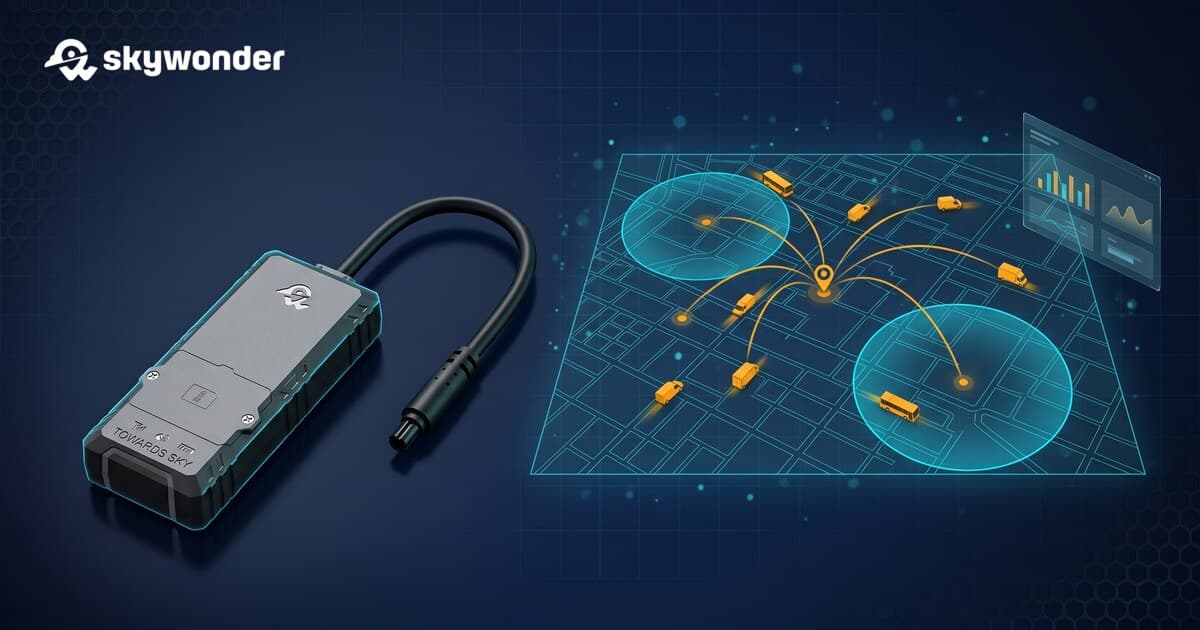
In short: A GPS fleet management system is four layers bought together: a tracker on each vehicle, optional video, a software platform, and cellular connectivity. Fleet size changes how you buy it. At 10 vehicles you buy a finished product, at 50 a factory order plus a platform account, and at 500 a supply agreement and an installation programme.
Written by Winnie Huang, Solution Manager at SKYWONDER Technology Co. Ltd. a Shenzhen GPS hardware manufacturer established in 2011, ISO 9001 certified, shipping to 100+ countries. Most of what follows comes from speccing deployments with fleet operators and with the resellers who serve them through our reseller program.
What does a GPS fleet management system consist of?
A GPS fleet management system has four layers: a tracking device in every vehicle, video cameras where evidence matters, a software platform that turns position reports into maps, alerts and reports, and a cellular SIM for each device. Buyers usually start by searching for a device or for software, then discover halfway through that they needed both plus two things nobody mentioned. Break the purchase into these four layers before you compare a single quote.
Layer 1: tracking hardware
One device per vehicle or asset, reporting position, ignition state, speed and alarms over cellular. The choices that matter are power source (hardwired, OBD plug, or battery), network generation, and what the device can sense beyond position, ignition (ACC), external fuel or power cut relay, tamper detection, fuel-level sensor input. Our vehicle GPS trackers and 4G GPS trackers cover hardwired and wire-free variants; the OBD tracker range covers plug-and-play; asset trackers cover trailers and unpowered equipment.
The one specification that quietly dictates the life of your deployment is the network. 2G and 3G networks are being switched off market by market, and a 2G-only fleet installed today is a re-installation bill tomorrow. We wrote the trade-offs out in 4G vs 2G/3G trackers.
Layer 2: video (optional, until it isn't)
Video is no longer a separate purchase bolted on later. Berg Insight counts the North American active installed base of video telematics at 7.6 million systems in 2025, forecast to reach 17.3 million by 2030 at an 18.0% CAGR, with Europe going from 2.0 million to 4.3 million over the same window (Berg Insight, The Video Telematics Market, 7th Edition, via IoT Business News, April 2026). Whether that video reports into the same platform as your tracking or into a second portal is an architectural decision you make at purchase time.
The split is channel count. One to three camera views from the windshield is 4G dash cam territory. Four to eight views, road, cabin, both blind spots, cargo bay, reversing, needs an MDVR box in the cab.
Layer 3: the software platform
The platform is where the fleet manager actually lives. Ours is Traqcare, available on web, iOS and Android, white-labelled to a partner's brand, with live tracking, route playback, alerts, geofences, fuel management, scheduled reports and device management. You can also run our hardware into a platform you already use, see the GPS tracking software page and the white-label platform comparison.
Layer 4: connectivity
Every device needs a SIM and a data plan, and this is the layer most first-time buyers forget to budget. Tracker traffic is small and predictable; video traffic is neither. We keep two calculators for exactly this: the 4G dashcam data usage calculator and the dashcam storage calculator. For tracker-only fleets, how much data a GPS tracker consumes has the arithmetic.
How do you size a fleet system for 10, 50 or 500 vehicles?
The same four layers get bought completely differently at different fleet sizes. Match your buying behaviour to your tier or you will overpay at the bottom and under-plan at the top.
Around 10 vehicles
At this size you are buying a finished product, not a system. One hardware model across the whole fleet, a hosted platform account, SIMs from a local operator, and installation by a local auto-electrician over two or three days. Do not attempt a mixed hardware fleet at 10 vehicles, the support overhead outweighs any per-unit saving. If you are buying for yourself rather than reselling, our fleet management solution page is the right entry point, and choosing a fleet tracking system covers the evaluation checklist.
Around 50 vehicles
Fifty is the threshold where the economics change. It is also, not coincidentally, where our MOQ sits: 50 to 100 units per model depending on the product, with white-label branding available from 100 units. At this size you buy hardware direct from the factory rather than through two layers of distribution, you negotiate a platform account rather than paying list, and you start caring about spares, budget replacement units and plan for the 12-month warranty process before you need it. GPS tracker MOQ explained covers what changes at each order band.
Fifty vehicles is also where you can afford one round of piloting. Order samples, 3 to 10 units, shipped in 5 to 7 business days, and run them on your two hardest vehicles for two weeks before committing the full order.
500 vehicles and up
Above a few hundred units you are running a programme, not a purchase. That means a supply agreement with staged deliveries rather than one container, a named hardware revision locked for the life of the rollout, a SIM strategy negotiated as a fleet contract, an installation schedule that follows your maintenance calendar rather than fighting it, and an integration path into your existing ERP or dispatch system. Berg Insight projects the Latin American installed base of fleet management systems alone at 20.6 million active units by 2030 (Berg Insight, Fleet Management in Latin America, via IoT Business News, June 2026), and the North American base is forecast to reach 33 million units by 2029 (Berg Insight, North America), at that scale integration and billing matter more than device price. Europe is on the same curve: Berg Insight (Fleet Management in Europe, 20th Edition, November 2025) counts 18.1 million active fleet management systems at the end of 2024 and forecasts 30.5 million by 2029, an 11.0 percent annual growth rate. In the GCC countries and Turkey, the same analyst puts the base at about 6.4 million units at the end of 2025, heading for 12.5 million by 2030 (Berg Insight via Zawya, 2026). Our developer documentation covers the protocol and integration side.
In-stock models ship in 3 to 7 days; custom builds run 15 to 25 days after deposit. A 500-vehicle rollout with a custom enclosure or firmware therefore starts a 15-to-25-day build, plus freight, before the first installer picks up a screwdriver, plan backwards from that.
Which tracking hardware fits which vehicle type?
Vehicle type, not fleet size, decides the device. A 500-van fleet and a 12-van fleet install the same tracker; a 12-truck fleet and a 12-van fleet do not. The table below maps our current SKUs to the vehicle classes they were built for.
SKYWONDER hardware by vehicle and asset type, 2026 range
| Vehicle / asset type | Recommended SKU | Install method | Capability that decides it |
|---|---|---|---|
| Cars, vans, light commercial | GT10 or GX3 | Hardwired, 9–95 V DC | Geofence, over-speed, vibration and power-cut alarms; GT10 adds an oil/power-cut relay output and voice monitoring, GX3 adds a low-voltage alarm |
| Trucks, heavy equipment, harsh electrical environments | GX7 | Hardwired, concealed | ACC input, relay control line, optional SOS and MIC channels, tamper and fall-detection alarms |
| Vehicles needing serial sensor expansion | H8 | Hardwired, waterproof housing | Optional TTL/RS485 channel for external sensors, plus ACC input, relay control line and optional SOS/MIC channels |
| Rental and short-hold vehicles | C30 4G OBD | OBD-II port, no wiring | Swaps between vehicles in seconds; GPS + BDS, 5–10 m accuracy |
| Trailers, containers, unpowered assets | W10 or GT76 | Magnetic, wire-free | Long-standby battery (W10 6,000 mAh, GT76 20,000 mAh) with intelligent power-saving; GT76 adds a light sensor that alarms on illegal removal, but its listed radio bands are 2G only, confirm network support for your market |
| Motorcycle and two-wheeler fleets | GX3 or SW16 | GX3 concealed and hardwired; SW16 wire-free | GX3 is 79 × 33 × 16 mm with vibration, low-voltage and geofence alarms; SW16 is an IP67 battery unit with geofencing and multi-mode positioning |
| Vans and cars needing road + cabin video | D9 or WD02 | In-cab, forward-facing | ADAS (FCW, LDW, pedestrian) and DMS (fatigue, smoking, distraction) on-device, live view over 4G |
| Single-camera AI retrofit on an existing tracker fleet | S202 | Cab-mounted, IP67 | 1080p with DSM and BSD, two-way intercom, alarm in/out with remote fuel and power cut-off |
| Trucks and buses needing 4–8 camera views | WD10 4-channel, WD10 8-channel or WD11 | In-cab MDVR box | ADAS/DMS/BSD and passenger counting in parallel; WD10 takes a 256 GB SD card plus a 2 TB SSD or hard disk, WD11 takes two 512 GB SD cards (1 TB) and exposes RS232/RS485; both expand to a fuel-level sensor |
| Buses and heavy vehicles needing 360° view or five in-cab channels | W108 or D12 | In-cab, multi-camera | W108 adds 360° bird's-eye stitching and face-recognition driver authentication; D12 records five 1080p channels and takes fuel, temperature, TPMS, passenger-counter and RFID peripherals on dual RS232; both have a 10.1-inch touchscreen (four-door passenger counting is a WD11 feature) |
Certifications across the range include CE, FCC, PTCRB, IC, RoHS and REACH, which ones apply to a given SKU and market is on the certifications page, and it is worth confirming before you order for a regulated market. India's AIS 140 is the clearest example: see AIS 140 compliance and the school bus solution.
Speccing a fleet deployment this quarter?
Send us your vehicle mix, country and unit count. We will come back with a hardware list per vehicle type, a Traqcare configuration, a tiered quote and a sample plan.
Request a fleet hardware quoteWhen does a fleet actually need video?
A fleet needs video when it faces liability disputes, when it has to correct driver behaviour that position data cannot show, or when a regulator or customer requires footage to be kept. Cameras are the largest single line item in a fleet system, so the decision deserves a reason rather than a trend. Those three reasons hold up in practice.
- Liability exposure. If a single at-fault determination against you costs more than equipping the fleet, video pays for itself on the first disputed incident.
- Driver behaviour you cannot fix with a speed report. Fatigue, phone use and following distance do not show up in position data. DMS and ADAS alerts do, in-cab, in real time, before the event. ADAS and DMS explained covers what each algorithm detects.
- Regulatory or customer video-retention requirements, common in passenger transport and in contracted logistics.
If none of those apply, run trackers only and revisit video at the next renewal. If they do apply, decide channel count first, then storage, then network, in that order, because storage and data cost scale with channels. Our dashcams speak JT/T 808 (and JT/T 1078 for streaming), while the trackers speak GT06; a mixed fleet therefore needs a platform that handles both protocols, so confirm protocol coverage before you split an order across trackers and cameras.
Platform features that actually matter
Most platform demos show the same map with the same moving dots. The differences that show up six months in are these:
- Alert quality, not alert quantity. A platform that fires 400 over-speed alerts a day trains your dispatcher to ignore all of them. Look for per-geofence thresholds, time-of-day rules, and alert suppression.
- Reports your accountant can use. Utilisation, idling, distance per driver, fuel consumption. See ten ways to reduce fleet costs for what each report is actually worth.
- Fuel management, which needs a fuel-level sensor wired to the tracker's serial input, a hardware decision made at install time, not a software toggle.
- Device management at scale. Remote configuration, over-the-air firmware, SIM and expiry tracking. At 500 units this is the difference between a maintainable fleet and a spreadsheet.
- White-labelling and multi-tenancy, if you are a reseller rather than an end fleet, covered in build vs buy for white-label platforms.
- Integration options, because sooner or later someone will want positions inside the dispatch system. The published Traqcare documentation does not describe a public API, SDK or webhook, so plan integration at the protocol level. GT06 and JT/T 808 references are on the developers page, or raise the requirement before you order.
If you are already committed to another platform, our devices are compatible with Traccar, Wialon, Navixy and GPS-Trace, so the hardware decision and the platform decision can be made independently. That flexibility is worth protecting: platforms get replaced more often than hardware does. Related reading: how a fleet GPS system helps the fleet manager.
What drives the total cost of a GPS fleet management system?
We do not publish prices, and any supplier who quotes you a per-vehicle figure before asking about your vehicle mix is guessing. What you can plan for is the shape of the cost. Six drivers move the number:
- Device class. A hardwired tracker, an OBD plug, a battery asset tag, a two-channel dashcam and an eight-channel MDVR are five different price bands. Mixing them by vehicle type, as in the table above, is the single biggest lever you have.
- Order volume and MOQ band. Pricing steps at 50, 100 and higher volumes. Ordering 90 units of one model usually beats 45 each of two.
- Customisation. Logo and packaging branding starts at 100 units; custom firmware, enclosures or certifications are a separate engineering line and add 15 to 25 days of lead time.
- Installation labour. Frequently underestimated. OBD is minutes; a concealed hardwired tracker is under an hour; a four-camera MDVR with cable runs is a half-day per vehicle. Multiply by fleet size before you compare hardware quotes.
- Connectivity. Recurring, per device, per month, and materially higher for video. Read SIM cards for GPS trackers before signing anything.
- Platform licensing. Per device per month in most commercial models, sometimes tiered by feature. This is the line that compounds, a licence that looks small at 10 vehicles is your largest operating cost at 500.
Two costs people forget entirely: spares (plan a small percentage of the fleet as shelf stock) and the freight and duty line, which for a container of hardware into a high-tariff market can rival the device cost. Importing GPS trackers from China walks through the landed-cost arithmetic.
On the other side of the ledger, the 2025 Verizon Connect Fleet Technology Trends Report, a survey of 543 fleet management professionals, found that average fuel savings from GPS tracking doubled from 8% in 2021 to 16%, accident-cost savings rose from 11% to 22%, and 47% of respondents reached a positive return on investment in under a year (Verizon Connect, November 2024). Those are a vendor survey's averages, not a promise for your fleet, but they explain why installation and platform configuration deserve a proper budget: the savings come from the reports being used, not from the device being fitted.
A rollout plan that survives contact with the fleet
Here is the sequence we see work, compressed into four phases. Timelines assume a 50 to 200 vehicle fleet.
Phase 1. Pilot (weeks 1–3)
Order 3 to 10 samples. Install on your worst vehicles, the oldest electrical system, the longest route, the weakest coverage area. Verify position accuracy, ignition detection, alert timing and platform reporting against reality, not against the datasheet. Confirm the SIM works where the vehicles actually go.
Phase 2. First batch (weeks 4–7)
Place the MOQ order for the models the pilot validated. In-stock models ship in 3 to 7 days; anything customised is 15 to 25 days after deposit. While hardware is in transit, configure the platform: geofences for your depots and customer sites, alert rules, user accounts and roles, report schedules. Do this before installation, not after, a fleet that goes live with default settings generates noise and loses the dispatcher's trust in week one.
Phase 3. Installation (weeks 6–10)
Install in waves that follow your maintenance schedule so vehicles are already off the road. Photograph every install location. Verify each device reports before the vehicle leaves the bay, a tracker discovered dead three weeks later costs a second workshop visit.
Phase 4. Operate and tune (weeks 10+)
Review alert volume weekly for the first month and tighten thresholds until alerts are actionable. Then start using the reports: utilisation, idling, unauthorised out-of-hours movement. Common fleet tracking problems covers the failure modes that show up in this phase.
How do resellers package a fleet system?
If you are selling fleet systems rather than buying one, the product you sell is not the tracker. It is a subscription with hardware attached. The packaging that works looks like this.
Pick two or three hardware tiers, not ten. A hardwired vehicle tracker, a wire-free asset tracker, and one video option covers the great majority of enquiries. Every extra SKU multiplies your stock, your training and your support load. Start with the models that match your market's vehicle mix, see the Africa 4G tracker guide for how that mix differs by region.
Brand the platform, not just the box. Traqcare white-labels to your logo, your domain and your app listings, which means your customer's daily experience of the product carries your name. Hardware branding is available from 100 units, details in the white-label GPS tracker guide.
Sell verticals, not devices. The same GT10 sells three completely different ways depending on the buyer: as theft recovery and payment enforcement to auto finance and BHPH dealers, as utilisation and damage evidence to car rental operators, and as temperature and route compliance to cold chain logistics. Two-wheeler fleets and delivery riders are their own market again, see motorcycle GPS tracking, and the motorcycle tracker selection guide. The full list is on the solutions overview.
Price recurring, not one-off. The hardware margin is finite; the platform subscription is annuity revenue. How to start a GPS tracking business covers the commercial model in detail, and the reseller program page covers our tier structure.
Get the reseller starter kit
The SKU list, the OEM tier breakdown, Traqcare white-label options and the pilot-order process, in one PDF. Tell us your market and we will send it over.
Eight mistakes that sink fleet deployments
- Buying 2G hardware in 2026. Network sunsets turn a cheap unit into a re-installation programme.
- Choosing hardware before choosing the platform. Or the reverse. Decide both together, and confirm the protocol is supported, GT06 for trackers, JT/T 808 for dashcams.
- Skipping the pilot. Ten units and two weeks will surface more problems than any datasheet review.
- Ignoring installation cost. On an MDVR deployment, labour can approach the hardware line.
- One model for a mixed fleet. A tracker chosen for vans will underperform on trailers and be overkill on rental cars.
- Going live with default alert thresholds. Alert fatigue kills adoption faster than any hardware fault.
- No spares plan. Devices fail, vehicles get written off, installers damage units. Warranty is 12 months, but a replacement in a warehouse beats a replacement in transit.
- Not checking market certification. Regulated markets. India's AIS 140, Brazil's Anatel, will stop a shipment at the border. Check the certifications page and our FAQ before you order.
Frequently asked questions
What is a GPS fleet management system?
It is the combination of a GPS tracking device installed in each vehicle, a cellular data connection for each device, a software platform that receives and interprets the position reports, and, increasingly, vehicle cameras feeding the same platform. The device reports location, ignition status, speed and alarm events; the platform turns that stream into live maps, route playback, geofence alerts, utilisation and fuel reports, and driver-behaviour scoring. See the fleet management solution for the full architecture.
How much does a GPS fleet management system cost?
There is no honest single figure, because the cost is driven by device class, order volume, customisation, installation labour, SIM data and platform licensing, and the mix of those changes completely between a 10-van fleet and a 300-truck fleet with cameras. Send your vehicle mix and unit count through the contact page and we will quote against a real specification rather than an average.
Can I use my own platform instead of yours?
Yes. Our trackers use the GT06 protocol and our dashcams use JT/T 808, and the range is compatible with Traccar, Wialon, Navixy and GPS-Trace. If you are building your own, the developers page has the protocol references and integration notes, note that the published Traqcare documentation does not describe a public API, SDK or webhook. If you would rather white-label ours, Traqcare covers web, iOS and Android under your brand.
What is the minimum order for fleet hardware?
MOQ is 50 to 100 units per model depending on the product, and white-label branding starts at 100 units. Samples are 3 to 10 units and ship in 5 to 7 business days. In-stock models ship in 3 to 7 days; custom builds take 15 to 25 days after deposit. GPS tracker MOQ explained has the detail per product family.
Do I need dashcams, or is a GPS tracker enough?
A tracker is enough if your questions are about where vehicles are, how they are being used, and whether they are being stolen. You need video when your exposure is liability disputes, when you need to correct driver behaviour that position data cannot see (fatigue, phone use, following distance), or when a regulator or contract requires video retention. Channel count then decides between a dash cam and an MDVR.
How long does it take to deploy 50 vehicles?
Plan eight to ten weeks end to end: two to three weeks of piloting with samples, three to four weeks for manufacturing and shipping the first batch (longer if customised), and two to four weeks of installation scheduled around your maintenance calendar. The platform configuration, geofences, alert rules, users, reports, should be finished while hardware is in transit.
Should I use local SIMs or a global IoT SIM?
Local SIMs are usually cheaper per megabyte and fine for a single-country fleet. Global or multi-network IoT SIMs cost more but survive cross-border routes and give you roaming redundancy where a single operator has coverage gaps, which matters more for video than for trackers. SIM cards for GPS trackers compares the options.
Can the whole system be white-labelled?
Yes, hardware branding and packaging from 100 units, and Traqcare under your own brand, domain and mobile apps. That combination is what most of our partners sell: their name on the box and on the app, our factory behind it. Start with the reseller program, or read the 2026 white-label platform comparison first.
Where to start
If you are a fleet: count your vehicles by type, pick one SKU per type from the table above, order samples, and pilot on your hardest routes. If you are a reseller: pick two or three SKUs, white-label the platform, and sell into one vertical properly before adding a second. Either way, the decision that matters most is the one made first, hardware that matches the vehicle, on a network that will still exist in five years, feeding a platform you can put your own name on.
We manufacture in Shenzhen, a 5,000+ m² factory, 200+ staff including 30+ in R&D, 20M+ units dispatched to date, ISO 9001, shipping to 100+ countries since 2011. More about how we build on the GPS tracker manufacturer page, or compare us against the field in the top 12 manufacturers for 2026. When you are ready with a vehicle list, the contact page is the fastest route to a specification and a quote.
Written by Winnie Huang
Winnie Huang is Solution Manager at SKYWONDER Technology Co., Ltd., matching fleet, logistics, school-transport and two-wheeler requirements to hardware, firmware and the Traqcare platform. She works with partners in India, Africa, Latin America and the Middle East on samples, pilots and volume rollouts.
Related Articles
View all
AIS-140 GPS Tracker Compliance: What Indian Fleet Operators Need to Know in 2026
A manufacturer's guide to AIS-140 compliance for Indian fleets: what a certified VLTD must include, the ARAI/ICAT certification path, state-empanelment traps, and the 2026 India compliance checklist.
Best 4G GPS Trackers for African Fleets in 2026 (Tested Across South Africa, Nigeria, Kenya, Ethiopia and Uganda)
A manufacturer's field guide to the best GPS tracker for Africa: 4G hardware picks, the 2027 2G sunset deadline, and country-by-country buying notes for South Africa, Nigeria, Kenya, Ethiopia and Uganda.
How to Start a GPS Tracking Business in 2026 (From Zero to First 100 Customers)
A GPS manufacturer's 6-step playbook for starting a GPS tracking business in 2026, from choosing your model to landing your first 100 customers.
Stay Updated with GPS Tracking Insights
Get the latest articles, tips, and industry news delivered to your inbox.