
How to Start a GPS Tracking Business in 2026 (From Zero to First 100 Customers)
A GPS manufacturer's 6-step playbook for starting a GPS tracking business in 2026, from choosing your model to landing your first 100 customers.
Sam K. Martin
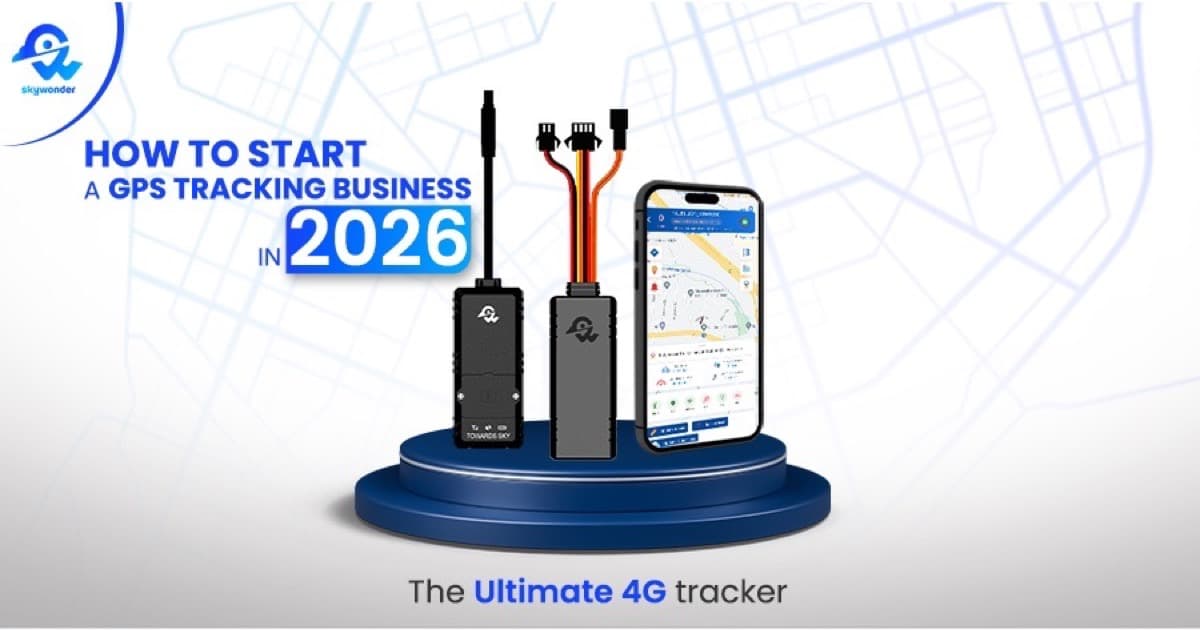
Short answer: To start a GPS tracking business in 2026, pick a business model (reseller, white-label, or OEM partner), source hardware factory-direct, run it on a white-label tracking platform, price it as a recurring monthly subscription, and sell into one vertical you understand. Most focused operators reach their first 100 customers within 9–12 months. This guide breaks that into six concrete steps.
Vehicle tracking has quietly become one of the most dependable hardware-plus-software businesses you can build. If you have been researching how to start a GPS tracking business, you have probably noticed something odd: most of the guides ranking today were written for enterprise fleet buyers, not for the entrepreneur who actually wants to build the company.
We want to fix that. At SKYWONDER, we have manufactured GPS trackers since 2011, shipped more than 20 million units, and onboarded partners across 100+ countries. We see, every week, exactly which new operators succeed and which stall.
A GPS tracking business is a company that sells vehicle or asset location hardware and bills customers a recurring fee for the tracking software that hardware feeds. That second half, the recurring fee, is why this model rewards patience. Below is the same six-step path we walk new partners through, ending with the question every founder asks: how do I get to my first 100 customers?
Is 2026 a Good Time to Start a GPS Tracking Business?
Yes, and the numbers are not subtle. The global GPS tracking device market was valued at roughly USD 3.60 billion in 2025 and is projected to reach USD 14.78 billion by 2035, a 13.69% compound annual growth rate, according to SNS Insider (2026).
The software side is growing even faster. The fleet management software market is forecast to expand from USD 32.34 billion in 2025 to USD 116.56 billion by 2032, a 19.76% CAGR, per Fortune Business Insights. Software grows faster than hardware because every device sold adds a subscription that compounds.
Demand is real, not speculative. In North America alone, the installed base of active fleet management systems hit 19.2 million units in late 2024 and is projected to reach 33.2 million by 2029, reports Berg Insight.

Here is the gap worth exploiting. That same Berg Insight data shows the top five vendors hold only about half of North America's active units, the rest is fragmented across thousands of regional operators. There is room. The opening for a new business is not competing with Geotab on enterprise contracts; it is owning a city, a region, or a single vehicle type that the giants ignore.
Want the numbers worked out for you?
Our Reseller Starter Kit includes a margin model, a hardware selection guide, and a launch checklist.
What Do You Need Before You Start a GPS Tracking Business?
Before you start a GPS tracking business you need five things: a registered business entity, a factory-direct hardware supplier, a multi-tenant tracking platform, basic installation capability, and one target vertical. You need less than most people assume, this is not a capital-heavy business, it is a relationship-and-recurring-revenue business. Line up these five essentials:
A registered business entity and a bank account that can take recurring payments. B2B fleet customers expect to pay a company, not a person.
A hardware supplier you can reach directly. Your supplier decides your margin and your warranty experience, choose before you choose anything else.
A tracking software platform that supports multiple customer accounts under one login.
Basic installation capability, either an in-house installer comfortable with 12V vehicle wiring, or a subcontracted auto-electrician. Plug-and-play OBD trackers reduce this need sharply.
A target vertical. Not "anyone with a vehicle", one specific group whose problems you can describe in their own words.
Notice what is not on that list: a warehouse, a software development team, or a large inventory. Telematics, the technology of sending vehicle data over a cellular network, has matured enough that the hard engineering is already done by your manufacturer and platform. Your job is distribution.
Step 1: Choose Your GPS Tracking Business Model
Your GPS tracking business model determines your margin, your brand equity, and how defensible the company becomes. There are five common models, and they sit on a spectrum from "easy to start, easy to copy" to "harder to start, hard to dislodge."
Five GPS tracking business models compared
Model | What you sell | Startup capital | Margin & brand equity | Best for |
|---|---|---|---|---|
SIM / airtime reseller | Connectivity only | Very low | Thin margin, no brand equity | Telecom side-businesses |
Hardware-only reseller | Trackers, no software | Low | One-time margin, no recurring revenue | Accessory shops, installers |
Hardware + platform reseller | Trackers + monthly software | Low–medium | Recurring revenue, moderate equity | Most new GPS businesses |
White-label brand | Your-brand hardware + app | Medium | Recurring revenue, strong equity | Operators building a sellable company |
OEM manufacturer-partner | Custom-spec hardware at scale | Medium–high | Highest margin, deepest moat | Established firms scaling volume |
Most readers should start in the middle, as a hardware-plus-platform reseller, and migrate toward white-label once monthly revenue is predictable. The reseller stage proves your market; the white-label GPS tracker stage builds an asset you could one day sell. Skipping straight to OEM before you have customers is the most common way new operators tie up cash they cannot afford to lose.
One honest opinion from the factory floor: the SIM-reseller and hardware-only models look attractive because they are simple, but neither produces recurring revenue. Without recurring revenue you are not building a GPS tracking business, you are doing GPS tracking transactions. The difference shows up in year two.
Step 2: Source Hardware From a Factory-Direct Manufacturer
Where you buy hardware is the single decision that most affects your survival. Every layer between you and the factory, importer, national distributor, regional wholesaler, takes a margin slice and slows down your warranty and firmware support.
Buying factory-direct does three things a distributor cannot. It removes a markup layer, so your margin survives competitive pricing. It gives you direct firmware and warranty support, so a field problem is solved in days, not weeks. And it unlocks white-label and OEM customization, your logo, your packaging, your app, which a distributor is not authorized to offer.
The second half of sourcing is matching the right device to the right customer. A GPS tracking business that offers one tracker for every job loses deals to operators who carry a real range:
Hardwired vehicle trackers for permanent fleet installs, for example the GX3 and GT10, with the GX7 and the WiFi-and-Bluetooth H8 for advanced use cases.
OBD plug-and-play trackers like the C28 for fast, no-wiring installs, ideal for rental fleets and quick pilots.
Wireless and portable trackers such as the W09 for trailers, containers, and unpowered assets, the portable W07 and W08 for movable equipment, and the GT33 ID-card tracker for lone-worker safety.
4G dashcams and MDVR units like the single-channel S202, the multi-channel D9, and the 8-channel WD10 for video evidence and driver-safety upsells.
That last category matters more every year. Roughly 1 million vehicles are reported stolen each year in the U.S. alone, per the National Insurance Crime Bureau, and video evidence is becoming a standard add-on, not a luxury.
Step 3: Choose Your GPS Tracking Software Platform
The hardware gets you in the door. The software is what customers pay for every month, so the platform decision is really a revenue decision. Your customers will judge your whole business by the dashboard they log into, even though you did not build it.
At minimum, the platform you build on should offer:
Real-time tracking and geofencing, a geofence is a virtual boundary that triggers an alert when a vehicle enters or leaves it.
Driver-behavior and fuel reporting, because that is where customers see measurable savings.
- Live alerts and trip history, instant notifications for speeding, geofence breaches, or low battery, plus replayable daily route maps for every vehicle.
Multi-tenant sub-accounts, so you manage every customer under one login while each customer sees only their own vehicles.
White-label branding, your logo, your colors, your domain, your iOS and Android apps.
An open API so you can integrate with billing, dispatch, or a customer's existing software.
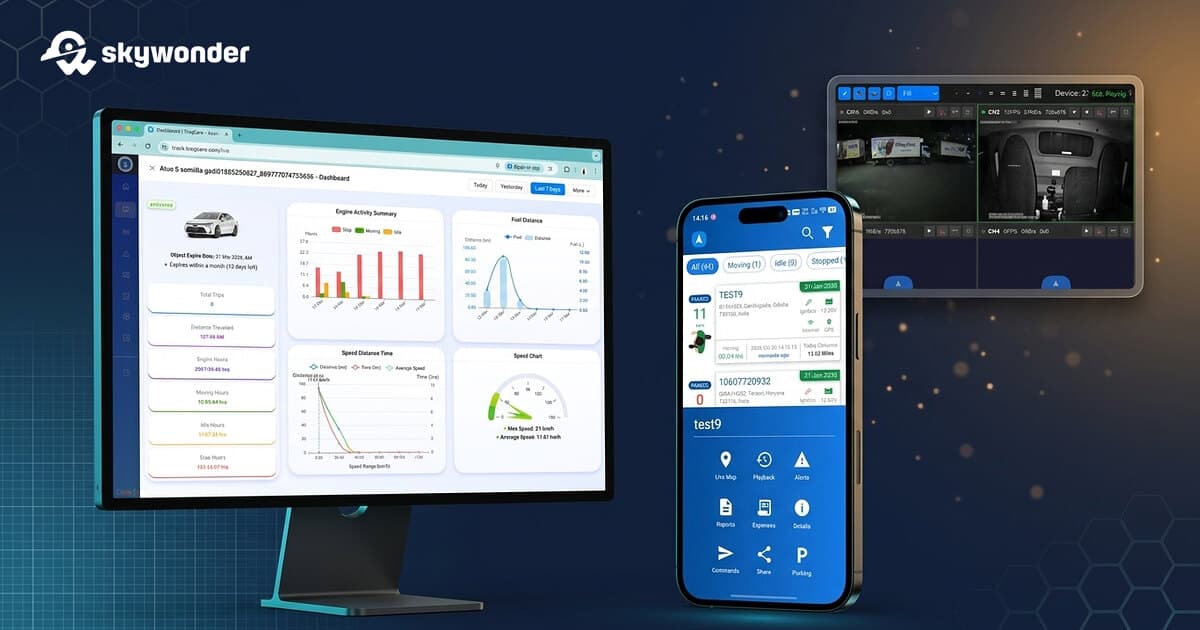
This is exactly why we built Traqcare, our own fleet platform, so SKYWONDER partners are never stranded on someone else's roadmap or hit with a sudden per-device fee increase. Whichever platform you choose, confirm two things in writing before you commit: that pricing is predictable as you scale, and that the white-label branding is genuinely yours, not a co-branded compromise.
Why this matters if you're still comparing suppliers
If you're at the stage of evaluating which manufacturer to partner with, the hardware spec sheet is the least important document. What decides your first two years is the contract underneath it: who controls firmware, how warranty claims are handled, whether the platform pricing is locked, and whether the brand on the app is yours. A factory-direct partner can answer all four in writing. A distributor usually cannot. Ask for those answers before you place an order, our Reseller Starter Kit gives you the exact checklist.
Step 4: Build Your Pricing and Recurring Revenue Model
Recurring revenue is the entire point. A healthy GPS tracking business sells hardware close to cost to win the customer, then earns its profit on a monthly per-vehicle software subscription that never stops.
For end-customer pricing context, fleet tracking subscriptions in mature markets commonly run in the range of USD 25–45 per vehicle per month, according to the U.S. Chamber of Commerce. (SKYWONDER hardware itself is sold on B2B and OEM terms, contact us for pricing, because partner economics vary by country and volume.)
Run the simple math. The figures below are an illustrative model, not a guarantee, but they show why operators stay patient:
Illustrative recurring-revenue model (modeled, not a quote)
Milestone | Customers | Approx. vehicles | Recurring revenue basis | Why it matters |
|---|---|---|---|---|
Launch | 10 | ~30 | Modest monthly recurring revenue | Proves the model works |
Traction | 25 | ~80 | Covers a part-time operator | Referrals start compounding |
Stability | 50 | ~160 | Covers a small full-time team | Business is now self-funding |
Scale | 100 | ~320 | Predictable annual recurring revenue | You can hire and reinvest |
Asset | 250+ | ~800+ | Compounding recurring base | The company is now sellable |
The lesson resellers learn slowly: customer number 100 is worth far more than customer number 1, because by then your recurring base funds acquisition for free. The first year is an investment; the second year is when the model pays you back. Verizon Connect's 2025 survey found 47% of fleets reach positive ROI on tracking within a single year, which means your customers feel the value fast enough to keep paying.
Step 5: How Do You Land Your First 10 Customers?
You land your first 10 customers by picking one vertical you already understand, leading with a live ROI demo, offering a short paid pilot, partnering with adjacent businesses like installers and insurers, and turning every install into a referral. The first 10 are the hardest, and the reason is psychological, not commercial: you have no proof yet. Telematics works, 69% of fleets already use GPS tracking and 72% call it extremely or very beneficial, per the Verizon Connect 2025 Fleet Technology Trends Report (n=543). Your problem is not the technology, it is being unknown.

Start with one vertical you already understand. Cold-chain delivery, taxis, construction plant, vehicle-finance lenders, pick the group whose language you can speak without translating.
Lead with an ROI demonstration, not a spec sheet. Show a live map and a fuel report. Buyers buy the outcome, not the OBD connector.
Offer a small paid pilot, five to ten vehicles for 30 days. A paid pilot removes the buyer's risk without devaluing your product the way "free" does.
Partner with adjacent businesses, auto-electricians, insurers, and asset-finance lenders all touch your customer before you do.
Convert every install into a testimonial. Photograph the install, log the first month's savings, and ask for one introduction.
Vehicle-finance lenders deserve special attention. They have a fleet-sized problem, protecting financed vehicles against default and theft, and they sign in volume. Which leads directly to how scaling actually happens.
Step 6: How Do You Scale From 10 to 100 Customers?
Scaling is not "do more of step 5." Steps 1 through 5 are founder-driven; step 6 is system-driven. The shift is from selling individually to building three repeatable engines: a referral engine, a vertical-expansion engine, and a retention engine.
From the field: 0 to 2,000 units in 10 months
SKYWONDER partner data, 2026. One of our distributors in Zimbabwe went from zero to 2,000 tracked units within 10 months of signing as a partner. They did not do it by chasing every vehicle in the country. They concentrated on a single vertical, vehicle-finance lenders who needed to protect financed cars, landed a handful of those lenders, and let each lender's loan book pull devices through in batches. One good vertical, sold deep, beats ten verticals sold shallow.
That story is the playbook in miniature. The referral engine works because a satisfied fleet manager knows other fleet managers; ask for the introduction at the 60-day mark, when the savings are visible. The vertical-expansion engine works because verticals share buying logic, once you have sold three taxi companies, the fourth is faster. The retention engine is the quiet one: every customer who churns is recurring revenue you must now re-earn, so a fast-support reputation is a growth strategy, not just a service standard.
Systematize installation as early as you can. A documented install process, the same wiring steps, the same QC photo, the same activation checklist, is what lets you add an installer without adding chaos. SKYWONDER partners who write this down at customer 20 scale far more calmly than those who wait until customer 80.
What Are the Most Common Mistakes New GPS Businesses Make?
The four most common mistakes new GPS tracking businesses make are underpricing the software, buying the wrong hardware for the job, selling to "everyone" instead of one vertical, and treating customer churn as normal. After 14 years of onboarding partners, we see the same four sink new operators, and all four are avoidable.
1. Underpricing the software. New operators discount the monthly fee to win deals, then discover the recurring revenue is too thin to fund support. The fix: compete on service and reliability, not on the subscription price.
2. Buying the wrong hardware for the job. Selling a hardwired tracker where an OBD unit belongs, or skipping dashcams entirely, costs installs and upsells. Carry a range and match the device to the use case.
3. Selling to "everyone." Without a vertical, every sale is a cold start. The Zimbabwe distributor's result came from focus, not from a wider net.
4. Treating churn as normal. In a recurring-revenue business, a lost customer is a permanent hole in next month's revenue. Track churn from customer one, and treat every cancellation as a problem to diagnose.
SKYWONDER B2B, OEM & White-Label Terms
If you are evaluating SKYWONDER as your manufacturing partner, here is the practical summary partners ask for most:
Manufacturer since 2011, 20M+ units shipped, partners in 100+ countries.
Certifications, hardware certified to CE, FCC, and RoHS; quality system certified to ISO 9001.
Low MOQ for new partners, start small, scale as your install base grows; OEM customization available at higher volumes.
Predictable lead times and direct firmware and warranty support, no distributor middle layer.
True white-label, your brand on the hardware, the packaging, and the Traqcare apps.
For current MOQ, lead time, warranty terms, and B2B or OEM pricing for your country, contact our partnerships team. We will model your entry economics with you rather than email a generic price list.
Starting a GPS tracking business in 2026 is a question of execution, not opportunity, the market is growing, the hardware is mature, and the recurring-revenue model rewards operators who focus. Pick your model, source factory-direct, choose a white-label platform, price for recurring revenue, and sell deep into one vertical. Your first 100 customers are a 9–12 month project, not a someday goal.
Ready to start your GPS tracking business?
The Reseller Starter Kit gives you the margin model, the hardware selection guide, and the launch checklist in one PDF.
Frequently Asked Questions
How much does it cost to start a GPS tracking business?
Startup cost depends on your model. A hardware-plus-platform reseller can begin with a small batch of trackers, a platform subscription, and basic installation tools. Buying factory-direct keeps the hardware investment low because there is no distributor markup. Contact a manufacturer for B2B pricing to model your exact entry cost for your country and volume.
Is a GPS tracking business profitable?
Yes, because it pairs one-time hardware margin with recurring software revenue. Each customer keeps paying a monthly per-vehicle fee, so profit compounds as the install base grows. The fleet management software market is projected to grow at a 19.76% CAGR through 2032, according to Fortune Business Insights, the recurring side is the faster-growing half.
Do I need technical skills to start a GPS tracking business?
No advanced engineering skills are required. Modern trackers are plug-and-play or OBD-based, and white-label platforms handle the software. You mainly need basic 12V vehicle-wiring competence for hardwired installs, or you can subcontract installation. In practice, sales and support skills decide success more than technical ones.
What is the difference between a GPS reseller and white-labeling?
A GPS reseller sells a manufacturer's branded product as-is. A white-label partner sells the same hardware and platform under their own brand, logo, and app. White-labeling builds equity because customers stay loyal to your brand, not the factory's, which matters most if you ever want to sell the company.
Where should I buy GPS trackers to resell?
Buy directly from a factory-direct manufacturer rather than a distributor. Factory-direct sourcing removes a markup layer, gives you direct firmware and warranty support, and unlocks white-label and OEM customization. SKYWONDER has manufactured GPS hardware since 2011 and ships to partners in 100+ countries.
How long does it take to get the first 100 customers?
Most focused operators reach 100 customers within 9 to 12 months. Speed depends on vertical focus: one SKYWONDER distributor in Zimbabwe deployed 2,000 tracked units within 10 months by concentrating on vehicle-finance lenders rather than selling to every vehicle owner.
Which GPS tracker should I start with?
Start with a small range, not one device. A hardwired tracker such as the GX3 covers permanent fleet installs, an OBD unit like the C28 handles fast no-wiring jobs, and a wireless model such as the W09 covers trailers and unpowered assets. Matching the device to the job is what customers pay you for.
About the author
Sam K. Martin leads B2B partnerships at SKYWONDER Technology Co. Ltd. a Shenzhen-based GPS tracker, 4G dashcam, and Traqcare fleet-platform manufacturer. SKYWONDER has manufactured tracking hardware since 2011, shipped more than 20 million units, and supports resellers, white-label brands, and OEM partners across 100+ countries. Sam works directly with new partners on launch strategy, hardware selection, and reseller economics.
Related reading: B2B Foundation
Related Articles
View all
Best 4G GPS Trackers for African Fleets in 2026 (Tested Across South Africa, Nigeria, Kenya, Ethiopia and Uganda)
A manufacturer's field guide to the best GPS tracker for Africa: 4G hardware picks, the 2027 2G sunset deadline, and country-by-country buying notes for South Africa, Nigeria, Kenya, Ethiopia and Uganda.

Top 8 White-Label GPS Tracking & Telematics Platforms for Service Providers (2026)
Compare the 8 best white-label GPS tracking platforms in 2026 across hardware support, AI features, and B2B pricing. Updated with SKYWONDER 2026 partner data.
White Label GPS Tracking Platform in 2026: Build vs. Buy vs. Rebrand (With the Cost Math)
A GPS manufacturer compares the build, buy, and rebrand routes to a white label GPS tracking platform in 2026, with real cost math and the margin model resellers actually use.
Stay Updated with GPS Tracking Insights
Get the latest articles, tips, and industry news delivered to your inbox.