
How to Import GPS Trackers from China in 2026: Complete Buyer's Guide (MOQ, Shipping, Customs, IP Protection)
A factory founder's walkthrough of importing GPS trackers from China: MOQs, freight, customs, IP protection, and how to pick a real manufacturer (not a trader).
Kumar Saurabh
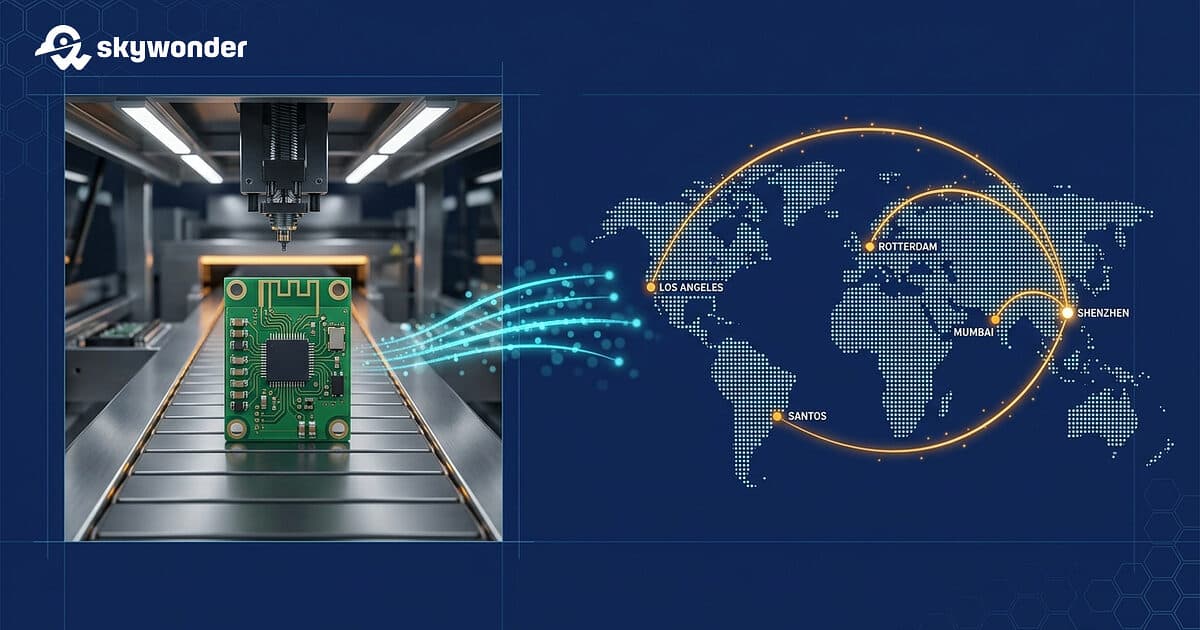
Short answer: To import GPS trackers from China in 2026, shortlist 3–5 real manufacturers (not traders), order production samples, lock a contract with clear MOQ + IP terms, and ship FOB or DDP under HS code 8526.91. Expect 35–75 days end-to-end, 100–3,000-unit MOQs depending on customization, and 0%–10% import duty plus local VAT in most destinations.
Every week, someone sends us a message that starts with "we want to import GPS trackers from China but we don't know where to start." Sometimes it's a Brazilian fleet integrator about to spin up a 5,000-vehicle deployment. Sometimes it's a one-person reseller in Nairobi who wants 100 units to test the market. The questions overlap more than you'd think.
We've been on the factory side of that conversation since 2011. SKYWONDER ships GPS trackers, 4G dashcams, and the Traqcare platform to 100+ countries, over 20 million units to date, so this guide is the one we wish we could hand every new buyer before the first email. It covers what actually matters: MOQs, shipping, customs, IP protection, and how to tell a manufacturer apart from a trading company that pretends to be one.
Why do most GPS trackers come from China?
The global GPS tracker market reached roughly USD 4 billion in 2024 and is projected to grow at 12–14% CAGR through 2030 (Mordor Intelligence, 2025). A very large share of the hardware that powers that market, by some industry estimates, more than 70%, is designed and assembled within a 200-kilometer radius of Shenzhen.
The reason is concentration. The Pearl River Delta cluster gives you SoC vendors, PCB houses, plastic injection moulders, antenna tuners, SIM-card slot suppliers, RF lab certifiers, and SMT production lines within a single day's drive. A tracker design that would take eight weeks to prototype in the US or EU goes from schematic to functional sample in about two weeks here. SKYWONDER runs its own SMT lines plus a dedicated firmware team, but even we lean on the cluster for specialty components.
For buyers, that translates into three structural advantages: lower unit cost (often 30–60% below Western contract manufacturing), faster iteration on custom firmware, and a deep enough vendor bench that one supplier going down rarely blocks your roadmap. The trade-off is that the ecosystem is noisy. Alibaba shows roughly 12,000 listings for "GPS tracker", and a meaningful share of those storefronts are trading companies rebranding hardware from a small number of real factories.
Who are the major China GPS tracker manufacturers?
Five or six companies make most of the hardware you'll see in the field. Knowing who actually builds what matters because buying directly from the manufacturer cuts out a 10–25% trading-company margin, and gets you a real engineering response window.
Here are the players we see most often on RFQs:
Concox / Jimi IoT, the originator of the GT06 protocol. Broad consumer and fleet hardware portfolio. Listed company; tends to have the highest MOQs.
Seeworld, Shenzhen-based manufacturer with asset and vehicle tracker range; high-volume wholesale focus.
Topflytech, OBD and asset tracker specialist; established channels in European fleet integration.
Queclink, public company (HKEX-listed), positioned for telematics service providers with strict certification requirements.
Meitrack, vehicle and personal tracker manufacturer; long-established export channels.
SKYWONDER, that's us. Hardwired vehicle (GX3, GT06, J10), OBD (C28), wireless asset (W07, W08, W09), 4G dashcams (D9, WD02, WD10), and the Traqcare fleet platform. 20M+ units shipped across 100+ countries since 2011.
Most other "manufacturers" you'll find on Alibaba are reselling from this short list. That's not bad, it just means you're paying an extra margin layer. For more on our own Shenzhen factory and manufacturing capabilities, see About SKYWONDER.
Want a wholesale quote from a real manufacturer?
We'll quote you direct from the factory, no trading-company middleman, no inflated MOQ.
What MOQs should you expect from a China GPS tracker manufacturer?
Minimum order quantity is the question we get every single day, and the honest answer is: it depends on how much customization you want. The MOQ is a function of how many lines on the bill of materials and the firmware are being changed for your order, not just unit count.
Across the deals we've closed in the last 18 months, the typical bands look like this:
Typical OEM MOQ tiers, SKYWONDER 2024–2026 customer data, n=180+ B2B contracts
Customization tier | What changes | Typical MOQ | Lead time |
|---|---|---|---|
Stock + custom logo | Printed/laser-etched logo on existing hardware | 100–300 units | 15–25 days |
Custom retail packaging | Stock device + your branded box, insert, manual | 300–500 units | 20–30 days |
Custom firmware on existing hardware | Server endpoint, protocol tweaks, custom command set | 1,000–3,000 units | 30–45 days |
White-label platform (Traqcare or equivalent) | Branded web + mobile app, custom domain, your logo | 500 units + platform fee | 30–45 days |
Custom hardware shell (new tooling) | New plastic injection mold, different button layout | 3,000–5,000+ units | 60–90 days |
Full custom hardware (new PCB) | New SoC, new sensors, new RF design | 5,000–10,000+ units | 90–180 days |
One pattern we see consistently: first-time buyers under-customize. They ask for the lowest MOQ and end up with a stock device with their logo on it. Six months in, they realize they wanted a different button layout, an extra LED, or a non-standard server protocol, and the cost of that change at order three is higher than it would have been at order one. If you have a clear product roadmap, build the MOQ ramp into your contract upfront with declining unit prices at each volume tier.
Across SKYWONDER's 2024–2026 OEM deals, the median first order was 280 units; the median second order from the same customer was 940 units; the median order at 12 months was 2,400 units. Order one is almost never the final MOQ, design for the relationship, not just the first shipment.
How does shipping and freight actually work?
Once production is done, the next decision is freight mode and Incoterm. Both have direct cash-flow implications: ocean freight is 2–4 weeks slower than air but typically one-fifth to one-tenth the cost per unit. The Incoterm decides who pays what and who carries the risk through customs.
The four Incoterms (under ICC Incoterms 2020) we see B2B buyers use most often for GPS tracker shipments are:
EXW (Ex Works), you pick up the goods from our Shenzhen warehouse. You handle export clearance, freight, import clearance, and last-mile delivery. Lowest invoice number, highest hidden complexity.
FOB Shenzhen / Yantian, we deliver to the port and clear export. You contract the freight forwarder, ocean freight, destination clearance, and last mile. The most common Incoterm for repeat B2B buyers.
CIF (destination port), we arrange ocean freight and basic marine insurance up to your destination port. You still handle import clearance, duty, and last mile. Useful for first orders when you don't have a forwarder relationship.
DDP (Delivered Duty Paid), we deliver to your door, customs cleared, duties paid. Highest invoice number, lowest buyer-side complexity. Margins are tight on DDP because customs surprises absorb our margin, not yours.
For freight mode itself: order under ~2 cubic meters (roughly 500–1,000 tracker units depending on packaging) usually goes air; 2–8 cubic meters goes LCL ocean (less-than-container-load, you share a container); 8+ cubic meters justifies an FCL 20-foot container. We've seen current Shenzhen-to-Los Angeles ocean transit running 25–35 days and Shenzhen-to-Rotterdam 35–45 days in early 2026, but rates can swing 30–50% on geopolitical events, check Freightos Baltic Index before you book.
What customs duties and HS codes apply?
GPS trackers usually classify under Harmonized System code 8526.91,"Radio navigational aid apparatus." This is the same HS heading the WCO maintains globally, so the first six digits (8526.91) are the same in almost every customs jurisdiction. The country-specific extension (the 7th–10th digits) and the duty rate vary.
You can confirm the destination duty rate before you book freight using these official portals:
US, HTS Search (USITC), look up 8526.91.00; current MFN rate from China is shown alongside any Section 301 add-ons.
EU, TARIC database, the EU's online tariff system.
India, ICEGATE, confirm BCD, IGST, and Social Welfare Surcharge.
Brazil, Receita Federal, Mercosur NCM lookup.
China, General Administration of Customs, confirms export classification on our side.
What we see customers miss most often isn't the import duty itself, it's the destination VAT/GST/sales tax, which can dwarf the duty. As a working example, on a USD 50,000 shipment of GPS trackers, the import duty might land at USD 0–4,000 depending on country, while the VAT alone (at a 19–21% EU rate, for instance) can add USD 9,500. Always quote total landed cost, not just CIF, when you're modeling B2B margin.
One Romanian fleet integrator we work with insisted on FOB their first order to "save on freight", then their forwarder mishandled the import declaration and the shipment sat in Constanța for three weeks racking up demurrage. The savings on freight were less than the demurrage bill. Their second order was DDP. If you don't have a customs broker you trust at the destination, DDP from a manufacturer who ships into your country every week is usually cheaper than the do-it-yourself version, once you price in delay risk.
How do you protect your IP when manufacturing GPS trackers in China?
Intellectual property protection is the area where we see the most expensive mistakes, and the most preventable ones. Three rules cover most of the risk surface:
1. Register your trademark in China before you start production. China is a first-to-file trademark jurisdiction (WIPO Madrid System). If you sell a tracker called "FleetGuard" in your home market and never register that name in China, a competitor (or a trading company you're working with) can register it locally and legally block you from exporting it. Registration runs roughly USD 500–1,500 per class and takes 9–12 months, start before your first sample order.
2. Use an NNN agreement, not a Western-style NDA. An NDA written for US or EU jurisdictions is often unenforceable in Chinese courts. The standard tool for protecting designs, firmware, and customer lists in a Chinese supplier relationship is a Non-Disclosure, Non-Use, Non-Circumvention (NNN) agreement, written in simplified Chinese, with jurisdiction in a Chinese court, and signed with the factory's official chop (red seal), not just an executive signature. A US-licensed China-IP attorney can produce one for a few thousand USD.
3. Split the bill of materials if your firmware is sensitive. For custom firmware that contains proprietary algorithms, we sometimes structure the build so the manufacturer assembles hardware and a separate trusted partner (or the customer) flashes the production firmware. This is overkill for 95% of orders but standard for high-IP-value designs.
For more on the OEM and white-label trust stack, see our OEM GPS tracker manufacturing guide.
Why this matters for a MOFU buyer evaluating manufacturers
If you're at the stage where you've identified GPS trackers as the right product but you're still picking a supplier, the cost of choosing wrong isn't the first order, it's the next twelve. Every supplier change burns 30–60 days of relearning their firmware quirks, re-certifying with carriers, and re-tuning your platform. The right framework is to optimize for the 24-month relationship: total landed cost, defect rate, engineering response time, and IP terms. Unit price at month one is the least important variable.
How do you vet a China GPS tracker manufacturer?
Vetting is the step most first-time buyers skip and most experienced buyers spend a third of their procurement budget on. The single best filter is this question: can the supplier answer engineering questions about their own PCB within one hour, in writing, without escalating? Real manufacturers can. Trading companies forward your question to the actual factory and come back a day later with vague answers.
The full checklist we'd run on a new supplier:
Verified Supplier badge on Alibaba (table stakes, not proof)
Business license showing manufacturing in scope (not just trading)
Cross-check on the China General Administration of Customs export records
Factory video walk-through with timestamps (not stock footage)
Engineering team org chart with named PCB and firmware leads
Two referenceable existing customers in your region
Certifications: CE, FCC, RoHS at minimum; ISO 9001 if at any production scale
Third-party pre-shipment inspection (SGS, Bureau Veritas, Intertek) acceptable
Sample order arrives matching the datasheet, not a "cousin" of the spec
Engineering response window under 24 hours on weekdays
Any supplier who refuses a factory video tour with timestamps (showing today's newspaper or that day's date on a whiteboard) is hiding something. We've made internal tours standard since 2019; if your prospective supplier won't, that's the answer.
Alibaba vs direct manufacturer vs trading company, compared
Most buyers end up touching all three channels at different stages. Knowing which one fits which order size saves a lot of margin. Here's the side-by-side we walk our partners through:
Sourcing channel comparison for GPS trackers from China
Dimension | Alibaba marketplace | Direct manufacturer | Trading company / agent |
|---|---|---|---|
Discovery speed | Fast, thousands of listings | Slow, needs RFQ + intro | Fast, agents have curated lists |
Unit price | Middle, listing-price markup baked in | Lowest, no middleman | Highest, agent margin layered on top |
Engineering response | Variable, depends on storefront | Fast, direct to firmware/PCB lead | Slow, agent escalates to factory |
IP / NNN enforcement | Limited, platform mediation | Strong, direct contract | Weak, extra party in the chain |
Payment protection | Trade Assurance escrow | 30/70 deposit, LC, or escrow | Often weaker than direct |
Best fit by order size | 1–500 units, market test orders | 500+ units, ongoing OEM | One-off complex bundles across SKUs |
MOQ flexibility | High, many tiers | Moderate, but transparent | High, agent can split orders |
Our recommendation for most B2B buyers: use Alibaba as a discovery channel, then take the relationship off-platform once you've identified the real manufacturer behind the listing. Continue paying via Alibaba Trade Assurance for the first 1–2 orders to build trust, then move to direct LC or wire transfer for ongoing volume. For more on choosing a partner, see our white-label GPS tracker manufacturing guide.
What does the end-to-end import workflow look like?
If you've never run this from start to finish, it can feel like 40 moving parts. It's really eight steps, and most of them sequence cleanly off each other. Here's the workflow we walk new B2B partners through:

Shortlist real manufacturers (Week 1–2). Build a list of 3–5 candidates. Verify on Alibaba + China Customs export database. Reject pure trading companies for ongoing work.
Send a structured RFQ (Week 2). Same RFQ to all 3–5 suppliers. Include specs, MOQ, target unit price band, lead time, required certifications, target Incoterm.
Order samples (Week 3–4). 3–10 production samples (not engineering samples). Test on your actual cellular network and tracking platform. Reject any supplier whose samples drift from the datasheet.
Negotiate the contract (Week 4–5). Lock MOQ, unit price by tier, lead time, payment terms (typical 30% deposit / 70% before shipment), warranty (typical 12–24 months), defect-replacement rules, and IP ownership for custom firmware.
Confirm HS code and import duties (Week 5). Run 8526.91 through the destination customs portal. Get a written quote from your customs broker including VAT/GST.
Choose freight mode and Incoterm (Week 5). Book FOB or DDP via your forwarder. Confirm container booking. For air, confirm dimensional weight against actual.
Pre-shipment inspection (production end). Schedule SGS, Bureau Veritas, or Intertek for any order above 500 units. 1–5% sample rate against your spec, at the factory, before release.
Customs clearance and delivery (transit + 5–15 business days). Provide commercial invoice, packing list, and bill of lading to your broker at the destination port. Pay duty + VAT. Plan 5–15 business days from port arrival to your warehouse.
For most first orders, plan on a 10–12 week window from "we want to import" to "stock in your warehouse." Subsequent orders compress to 5–8 weeks because the contract, certifications, and broker relationship carry over.
Common pitfalls we see (and how to avoid them)
Patterns we see repeatedly in failed or painful import projects, in rough order of frequency:
Skipping production samples. Engineering samples and production samples are different things. The engineering sample is hand-assembled by the firmware team. The production sample comes off the same SMT line your order will. Always test the production sample.
Treating Alibaba Verified Supplier as proof of quality. It's a baseline check, not a quality endorsement. Plenty of verified suppliers are trading companies.
Choosing the lowest unit price without pricing defect rates. A USD 22 tracker with a 4% defect rate costs you more than a USD 26 tracker with a 0.5% defect rate, once you price in RMA shipping, support tickets, and customer churn.
Missing local VAT in landed-cost models. The 19–25% VAT in most of Europe is bigger than any import duty. Always quote total landed cost.
Negotiating only the first order's price. Negotiate the 12-order price curve. Your supplier knows you'll come back; lock in volume tiers now.
Not registering trademark in China before production. First-to-file jurisdiction. Filing after production starts is too late if a competitor or trader files first.
Sharing full schematics with a trading company. If your design is sensitive, the agent doesn't need the full BOM. Restrict information flow to what each party needs.
Underestimating certifications. CE/FCC/RoHS aren't optional. RED (EU) and PTCRB (US carrier acceptance) take 4–8 weeks if not already in hand. Plan accordingly.
The single highest-leverage move we see successful importers make is to spend the first 30–45 days of their first order's production lead time visiting the factory in person (or arranging a third-party audit). The cost is USD 1,000–3,000. The information arbitrage from one day on the production floor is worth more than three months of email exchanges.
Ready to start your first order?
We'll quote you direct from our Shenzhen factory, GX3, GT06, J10, C28, W07/W08/W09 trackers, D9/WD02/WD10 dashcams, and Traqcare white-label platform. MOQ from 100 units. Send us your specs.
SKYWONDER B2B, OEM & white-label terms
MOQ: 100 units (printed logo) · 300 units (custom packaging) · 1,000 units (custom firmware) · 5,000 units (custom hardware tooling)
Lead time: 15–25 days (stock + logo) · 30–45 days (custom firmware) · 60–90 days (custom hardware)
Payment terms: 30% deposit / 70% before shipment · LC at sight (orders over USD 50,000) · Trade Assurance via Alibaba for first orders
Warranty: 12-month standard, 24-month extended available · DOA replacement within 30 days · Out-of-warranty repair service
Certifications: CE, FCC, RoHS, IEC 62133 (battery), ISO 9001:2015 (quality management). Custom certifications (Anatel BR, IC CA, IFETEL MX) on request.
OEM tiers: Printed logo · Custom packaging · Custom firmware · Custom hardware shell · Custom PCB · White-label Traqcare platform
Shipping: FOB Shenzhen / Yantian · CIF / DDP available · Air, LCL, FCL options · Direct shipping to 100+ countries
Engineering response window: Under 24 hours weekdays · Named PCB + firmware lead assigned per partner account
Frequently asked questions
What is the minimum order quantity for OEM GPS trackers from China?
MOQs vary by SKU and customization level. For standard models with a printed logo, 100–300 units is common. For custom firmware or custom hardware shells, expect 1,000–3,000 units. At SKYWONDER, our hardwired vehicle tracker MOQ starts at 100 units for logo-only branding and 1,000 units for custom firmware on existing hardware.
How long does it take to import GPS trackers from China?
End-to-end timeline runs 35–75 days for a standard order. Production: 25–45 days. Ocean freight: 25–35 days to the US West Coast, 35–45 days to Northern Europe, 15–25 days to Southeast Asia and India. Air freight cuts transit to 5–10 days but typically triples the per-unit shipping cost.
What customs duty applies to GPS trackers in 2026?
GPS trackers usually fall under HS 8526.91 (radio navigation aid apparatus). Duty rates vary widely by destination: 0% to most-favored-nation rate for many countries, plus VAT/GST/sales tax. Confirm the specific rate on your destination country's official customs portal before booking freight. We see customers most often miss the local VAT, not the import duty itself.
How do I know if a Chinese GPS tracker supplier is a real manufacturer or a trading company?
Ask for a factory video walk-through with timestamps, an engineering team org chart, and the supplier's business license showing manufacturing scope (not just trading). Cross-check against the China General Administration of Customs export database. Real manufacturers can answer engineering questions about their PCBs in under an hour; traders escalate.
Can I get custom branding (OEM/white-label) on GPS trackers from China?
Yes. Three OEM tiers are common: (1) printed-logo only on existing hardware (lowest MOQ), (2) custom packaging plus app/platform white-label (moderate MOQ), and (3) custom hardware tooling (highest MOQ, typically 3,000–5,000+ units). SKYWONDER offers all three tiers, including white-label of the Traqcare fleet platform.
How do I protect my IP when manufacturing GPS trackers in China?
Register a Chinese trademark BEFORE production starts (China is first-to-file, not first-to-use). Use an NNN agreement instead of a Western-style NDA. Split the bill of materials across two suppliers if firmware is sensitive. Require source-code escrow for custom firmware. Avoid sharing your full schematic with the trading layer.
Should I buy GPS trackers on Alibaba or directly from a manufacturer?
Alibaba is a discovery channel. Once you've shortlisted 3–5 suppliers there, take the conversation off-platform to evaluate them properly. For one-off small batches, Alibaba Trade Assurance is reasonable protection. For ongoing OEM relationships above 500 units per month, a direct manufacturer contract gives you better margins, faster engineering response, and tighter IP control.
About the author
Kumar Saurabh is heading overseas business of SKYWONDER Technology Co., Ltd., a Shenzhen-based GPS tracker, 4G dashcam, and fleet-platform manufacturer that has shipped 20+ million units to 100+ countries since 2011. He writes about manufacturing, B2B telematics, and the China hardware supply chain.
Related reading: Importing & Sourcing
Written by Kumar Saurabh
Kumar Saurabh leads platform and protocol engineering at SKYWONDER Technology Co., Ltd. (Shenzhen, founded 2011). With 15+ years in GPS hardware, telematics software and IoT systems, he writes about GT06 and JT/T 808 integration, the Traqcare platform, and how resellers build tracking businesses on factory-direct hardware.
Related Articles
View all
Top 8 White-Label GPS Tracking & Telematics Platforms for Service Providers (2026)
Compare the 8 best white-label GPS tracking platforms in 2026 across hardware support, AI features, and B2B pricing. Updated with SKYWONDER 2026 partner data.
White Label GPS Tracking Platform in 2026: Build vs. Buy vs. Rebrand (With the Cost Math)
A GPS manufacturer compares the build, buy, and rebrand routes to a white label GPS tracking platform in 2026, with real cost math and the margin model resellers actually use.
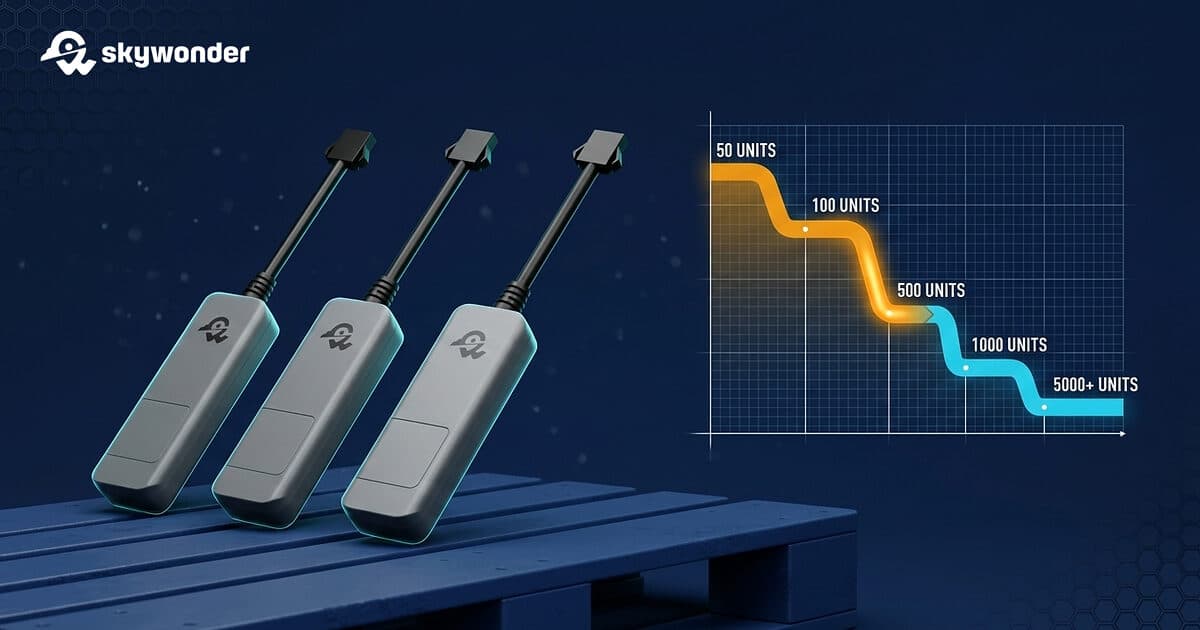
GPS Tracker MOQ Demystified: What 50, 100, 500, 1000+ Actually Buy You
A factory partnerships lead walks through what each GPS tracker MOQ tier really gets you, from a 50-unit sample pack to a 5,000-unit OEM run.
Stay Updated with GPS Tracking Insights
Get the latest articles, tips, and industry news delivered to your inbox.