
Best 4G GPS Trackers for African Fleets in 2026 (Tested Across South Africa, Nigeria, Kenya, Ethiopia and Uganda)
A manufacturer's field guide to the best GPS tracker for Africa: 4G hardware picks, the 2027 2G sunset deadline, and country-by-country buying notes for South Africa, Nigeria, Kenya, Ethiopia and Uganda.
Sam K. Martin
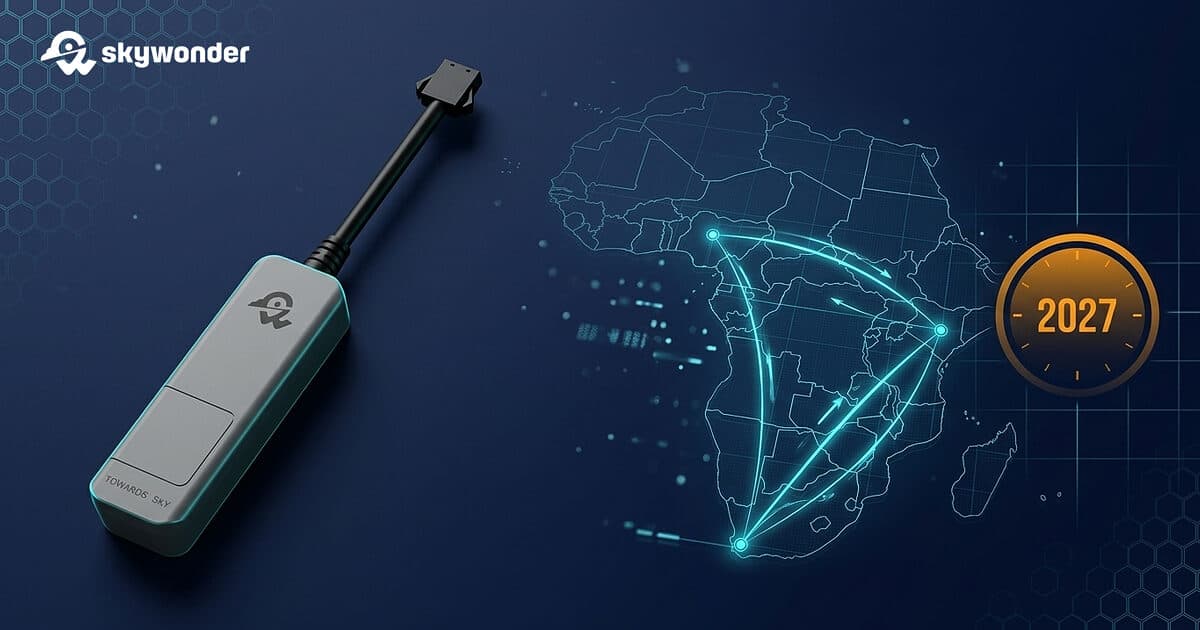
Short answer: The best GPS tracker for Africa in 2026 is a hardwired 4G LTE unit with a 2G fallback, a remote fuel or power cut-off, and blind-spot data buffering for patchy coverage. South Africa shuts down 2G and 3G by 31 December 2027, so 2G-only hardware bought today already has an expiry date. For SKYWONDER fleets, the J10 and GT06 lead on vehicles, the GT76 covers unpowered assets, and the D9 adds driver-safety video.
Picking a GPS tracker for Africa is not the same problem as picking one for Europe or North America. The power is rougher, the coverage is patchier, the theft risk is higher on key corridors, and the cellular networks underneath your whole fleet are about to change generation. Buy the wrong device in 2026 and you could be re-fitting the entire fleet in eighteen months.
At SKYWONDER we have manufactured GPS trackers since 2011 and shipped more than 20 million units, with partners in 100+ countries including a growing base across Africa. This guide is the conversation we have with African distributors and fleet operators, written down: which 4G hardware fits, why the network sunset sets your deadline, and how the right device changes by market from Johannesburg to Lagos to Nairobi.
Why does the 2G and 3G sunset make 4G the only safe GPS tracker for Africa in 2026?
Because the cheapest 2G tracker on the market today is hardware with an expiry date. In 2026, South Africa has gazetted a full 2G and 3G network shutdown for 31 December 2027, service shutdowns began on 1 June 2025, and activation of new 2G/3G-only devices has been banned since the end of 2024 (Connecting Africa, "South Africa pushes 2G, 3G sunset to 2027," 2025). A device that cannot reach 4G is on a countdown.
Here is the part most buying guides miss. That shutdown date is not just a network story. It is your hardware purchase deadline. Every 2G tracker fitted in 2026 has to be ripped out and replaced before the networks go dark, and re-fitting a fleet costs far more in labour than the device ever cost to buy. The migration is already in motion: as of March 2024, MTN reported 64% of its customers still on 3G and Vodacom 50%, a large legacy base the operators are now pushing onto 4G (Connecting Africa, 2025).
So what should a fleet do right now? The safe move is 4G LTE hardware that falls back to 2G in the gaps, not 2G hardware hoping to last. You get the modern network where it has rolled out, and a working fallback on rural corridors where 4G has not reached yet.

How to migrate a fleet from 2G to 4G before the deadline
The migration is not complicated, but the sequence matters. Rushing a full swap without a pilot is how operators end up with a thousand units that report badly on their actual routes. Work through it in four steps:
Audit the installed base. List every tracker by network generation. Flag the 2G-only and 3G-only units, because those are the ones that go dark at the sunset.
Confirm 4G coverage and local type approval. Check 4G LTE coverage on your real routes, then confirm the hardware carries the local type approval (ICASA in South Africa, NCC in Nigeria, CA in Kenya).
Choose 4G hardware with a 2G fallback. Pick LTE trackers that drop to 2G in coverage gaps, so a unit keeps reporting on rural corridors where 4G has not arrived.
Pilot, then phase the rollout. Run a 50-unit pilot, confirm install time and reporting quality, then phase the full replacement well ahead of December 2027.
Building a fleet-tracking business in Africa?
The sunset is the biggest replacement opportunity African resellers have seen in a decade. We work with distributors directly, factory to partner, with a 50-unit pilot to start and B2B pricing on request.
Become a SKYWONDER Africa DistributorThe African fleet GPS tracking market in 2026 is large and under-penetrated
It is large, growing, and still under-penetrated. South Africa's installed base of active fleet management systems was around 2.1 million units and is forecast to reach 3.8 million by 2027, a 12.2% compound annual growth rate (Berg Insight, via Telematics Wire, 2023). By one market-research estimate, the wider Sub-Saharan commercial vehicle market sat near USD 15.19 billion in 2024 and could reach USD 23.88 billion by 2030 (MarkNtel Advisors, 2025), a directional figure rather than an audited census.
Demand for a capable GPS tracker in Africa is following the network. In 2024, 4G connections made up around 45% of total mobile connections in Sub-Saharan Africa, rising toward the majority of connections by 2030, as the mobile sector contributed roughly USD 240 billion to the continent's economy (GSMA, "The Mobile Economy Africa 2025"). Tracking hardware rides on that same 4G rollout, which is exactly why the device generation you choose now is a multi-year bet.
Who is selling into that demand? Subscription-first tracking brands dominate the headlines. Cartrack's subscriber base grew 15% to more than 2.4 million users globally for the half-year ended 31 August 2025 (Bizcommunity, 2025). That model works for end fleets, but it locks the customer into a monthly contract and a closed device. We sit on the other side of the table: we sell the hardware, you own the customer relationship.
Disclosure: SKYWONDER has no business relationship with Cartrack, Samsara, or Concox / Jimi IoT. We name them as reference points in the market, not as partners. The reorder figures below are SKYWONDER 2026 partner-onboarding data (n=84), our own first-hand records, not a third-party study.
Where do we fit against the names a distributor will compare us to? Cartrack and similar brands are subscription tracking services, not hardware you can rebrand. Samsara is a strong platform, but US-centric and priced for North American fleets. Concox and Jimi IoT originated the GT06 protocol and ship at scale, and we compete with them on direct-factory terms: low MOQ for stock, a dedicated engineer at OEM tier, and the option to bundle our Traqcare tracking platform as a white-label stack.
What makes a GPS tracker right for Africa, specifically?
Five things separate a tracker that survives African conditions from one that fails in the field. A GPS tracker is a small cellular computer wired into a vehicle, so when the power is dirty, the coverage drops, or a thief goes looking for it, the device has to keep working anyway. After shipping into 100+ countries, these are the specifications that make a GPS tracker for Africa worth its price, and the ones we tell African buyers to check first.
4G LTE with a real 2G fallback. The modern network where it exists, a working fallback where it does not. This is non-negotiable past the 2027 sunset.
Wide band coverage for cross-border routes. A unit that roams across MTN, Vodacom, Airtel, Safaricom and MTN Nigeria needs a broad LTE band set, not a single-band module locked to one carrier.
Wide-voltage input and surge tolerance. Truck and bus electrical systems in the field are rough. A 9V to 90V class input range absorbs the spikes that kill narrow-spec hardware.
Blind-spot data buffering. On a corridor with coverage gaps, the device should store positions offline and re-transmit when signal returns, so you do not lose the route.
Anti-theft hardware: cut-off plus tamper alerts. A remote fuel or power cut-off relay, and a removal or light-sensor alarm that fires when the device is pried out of its hidden mount.
Our finding (engineering note, Kumar Saurabh): blind-spot buffering is the spec African buyers underrate most. Our J10 stores up to 1,000 positioning logs offline and replays them when the network returns, and the GT06 supports the full LTE-FDD band set (B1/B2/B3/B4/B5/B7/B8/B28/B66) plus GSM, which is why a single GT06 SKU roams cleanly across most Sub-Saharan band plans. Those two specs do more for real-world data continuity than a faster reporting interval ever will.
Notice what is not on that list: a flashy app, a "premium" badge, or the lowest possible sticker price. Does a cheaper 2G unit save money today? On paper, yes. The moment you factor the 2027 re-fit and the lost vehicles to theft, the math flips hard.
Which SKYWONDER 4G GPS trackers are best for African fleets?
There is no single best tracker, there is a best tracker per job. A long-haul truck, an unpowered trailer, a self-install rental car, and a passenger bus each want different hardware. The table below maps our most-deployed 4G devices to the fleet job they fit, drawn from our own product specifications rather than a competitor's list.

SKYWONDER 4G GPS trackers for African fleets: which device fits which job
Model | Best for | Network | Positioning | Install effort | Standout feature for Africa |
|---|---|---|---|---|---|
Hardwired fleet vehicles, anti-theft | 4G LTE (2G GSM variant available) | GPS + BeiDou + GLONASS + AGPS | Hardwired (DC 9 to 90V) | Light-sensor removal alarm plus remote fuel cut-off; buffers 1,000 logs offline | |
Cross-border vehicles, no forced subscription | 4G LTE full-band (CAT-1 / NB-IoT / 2G optional) | GPS + BeiDou + AGPS + LBS | Hardwired (DC 9 to 95V) | Widest LTE band set for multi-country roaming | |
Fleets needing fuel or temperature sensors | 4G | GPS + BeiDou + AGPS | Hardwired | RS232 and RS485 ports for fuel-level and cold-chain peripherals | |
Trailers, gensets, unpowered assets | 4G | BeiDou / GPS / WiFi / LBS | Magnetic, no wiring | Long standby battery, 180-day history, removal alarm | |
Self-install cars, light commercial | 4G | GPS + BeiDou | OBD-II plug, under 5 minutes | Plug-and-play, no wiring or installer needed | |
Driver safety, video evidence | 4G + WiFi | GPS / GNSS | Windshield plus power harness | Dual 1080p ADAS and DMS, JT/T808 and JT/T1078 | |
Buses, trucks, multi-camera | 3G / 4G + WiFi | GPS | Multi-camera wired install | 4 to 8 channels, ADAS / DMS / BSD, up to 2TB storage |
If you want one starting point, it's the J10. It's our best-selling hardwired vehicle tracker, it ships in both 4G LTE and 2G GSM variants (specify the 4G LTE version for any new African deployment), and its light-sensor removal alarm and remote cut-off are built for exactly the theft profile these routes see. The full range, including OBD and asset SKUs not listed above, lives in the product catalog.
How do you choose by country: South Africa, Nigeria, Kenya, Ethiopia and Uganda?
The right GPS tracker for Africa shifts with the local problem. Theft drives the spec in South Africa, fuel cost drives it in Nigeria, and self-install convenience drives it in fast-growing East African markets. Here is how we'd brief a distributor in each market, with the local type-approval body named, because generic "make sure it's certified" advice helps nobody.
South Africa: anti-theft first
South Africa is a theft-led market. Police recorded 4,420 carjackings in the fourth quarter of 2025 alone, around 48 vehicles hijacked per day, with Gauteng accounting for 2,544 of them, more than half the national total (SAPS data via BusinessDay, 2026). The hardware answer is hardwired and tamper-aware: the J10 with its remote cut-off and light-sensor removal alarm, often paired with a hidden second unit. Local type approval is handled by ICASA.
Nigeria: fuel and freight
Nigeria is a fuel-cost market. Fuel reportedly accounts for around 40% of trucking cash outflows there, the single largest controllable cost on a logistics route (Mordor Intelligence, 2025). That is the case for the GT10, whose RS232 and RS485 ports take a fuel-level sensor so you can see siphoning and idling against actual tank data, not just mileage. Local type approval is handled by the NCC.
Kenya: logistics and self-install scale
Kenya's transport sector is growing fast and spread across many small operators, from matatu owners to regional logistics firms. That favours fast, low-skill deployment: the C30 4G OBD tracker plugs into the diagnostic port in under five minutes with no installer, while larger fleets standardise on the hardwired GT06. Local type approval is handled by the Communications Authority (CA).
Ethiopia and Uganda: ride the 4G rollout
Ethiopia and Uganda are earlier in their telematics curve, and reliable fleet-penetration data is thin, so we'd brief these markets qualitatively. The pattern is consistent: 4G coverage is expanding from the cities outward, so the safe choice is 4G hardware with a solid 2G fallback for the long rural corridors. Confirm the local type-approval path first (Ethiopia's ECA, Uganda's UCC) before any sizeable import.
Why this matters if you're building a fleet-tracking business in Africa
If you're a distributor or reseller, the country differences are your edge. A subscription brand sells one closed device the same way in every market. You can fit the J10 to a Johannesburg anti-theft customer, the GT10-with-fuel-sensor to a Lagos haulier, and the C30 to a Nairobi rental fleet, all on the same hardware account, all on hardware you own. The 2G sunset hands you a replacement cycle that runs through 2027. The question is whether you're sourcing that hardware from a factory or from a trader reshipping someone else's stock.
Do African fleets need dashcams and driver monitoring too?
Increasingly, yes, and the road-safety numbers explain why. The WHO African Region carries the world's highest road-traffic fatality rate at 19.4 deaths per 100,000 people, with almost 250,000 road deaths across Africa in 2021 (WHO Regional Office for Africa, 2023). For a fleet, that is both a human cost and a hard insurance and liability cost. A camera that warns the driver before an incident, and records evidence after one, pays for itself fast.
This is where a GPS tracker grows into a safety device. The D9 is a dual-camera 4G dashcam that runs ADAS and DMS on-device. What does that actually do on the road?
ADAS warns before a crash. Forward-collision warning, lane-departure warning, and pedestrian detection alert the driver in real time, not after the fact.
DMS watches the driver. Fatigue, distraction, phone use, and smoking detection catch the behaviour that causes most preventable incidents.
Video gives you evidence. Dual 1080p recording, forward and in-cabin, settles disputes and insurance claims with footage instead of argument.
For buses, trucks, and other multi-camera vehicles, the WD10 MDVR scales the same idea to four or eight channels with blind-spot detection and up to 2TB of onboard storage. Both speak the JT/T808 and JT/T1078 transport protocols, so they plug straight into the Traqcare platform alongside your trackers. One platform, trackers and cameras together.
SKYWONDER's B2B, OEM and Africa distributor terms
If you're evaluating us as your manufacturing partner for an African rollout, here's the practical summary distributors ask for most. For your country, your SKU mix, and your projected volume, current B2B and OEM pricing is on request, never published as fixed retail.
Manufacturer since 2011, 20M+ units shipped as of Q2 2026, 84 new reseller partners onboarded across 2025 and H1 2026, partners in 100+ countries.
Stock MOQ: 50 units per model across most SKUs in the full product catalog, including the J10, GT10 and GT06 hardwired vehicle trackers, the C30 OBD tracker, the GT76 asset tracker, and the D9 and WD10 dashcams. New partners can mix SKUs to hit the floor.
OEM MOQ: 500 units for logo printing and custom box, 1,000 units for white-label firmware, 5,000 units for molded plastics or hardware-level customization.
Lead time: 3 to 7 days at 50 to 100 units, 2 to 3 weeks at 500, 4 to 6 weeks at 1,000+ with custom firmware, confirmed in writing at quotation.
Warranty: standard 12-month RMA, with batch traceability from 500 units up, and a dedicated firmware support engineer assigned at the 1,000-unit tier.
Certifications: hardware certified to CE, FCC and RoHS, quality system certified to ISO 9001. Hardwired vehicle trackers also address e-Mark (UN ECE R10), and battery-powered units ship under UN 38.3 for international transport.
Local type approval: CE / FCC / RoHS are the factory baseline. For OEM-branded shipments, the buyer of record confirms the local type approval (ICASA, NCC, CA, ECA, UCC) with a regional lab before a large rollout. We provide the documentation to support that filing.
Traqcare platform option: if you'd rather not contract a separate tracking-software vendor, our Traqcare GPS tracking platform ships as a white-label option alongside the hardware. One vendor, one warranty.
Want the full picture before you talk to us? Pull the Africa Fleet SKU catalog and distributor tier sheet (PDF), which lays out the vehicle, OBD, asset and dashcam SKUs with the OEM tier breakdown. For background on the factory itself, see About SKYWONDER.
The 2G sunset is your replacement cycle. Own it.
Africa's fleets are moving to 4G on a fixed clock that runs through 2027. The distributors who lock in the right hardware partner now are the ones who'll carry that replacement wave. Start with a 50-unit pilot and scale on the orders that follow.
Frequently Asked Questions
What is the best GPS tracker for fleets in Africa in 2026?
For most African fleets in 2026 the best GPS tracker is a hardwired 4G LTE unit with a 2G fallback, a relay-based fuel or power cut-off, and blind-spot data buffering for patchy coverage. At SKYWONDER the J10 and GT06 cover that brief for vehicles, the GT76 covers unpowered assets, and the D9 adds ADAS and DMS for driver safety. Specify the 4G LTE variant, since 2G-only devices will not survive the network sunset.
Why should African fleets buy 4G GPS trackers instead of cheaper 2G ones?
South Africa has gazetted a full 2G and 3G shutdown for 31 December 2027, and activation of new 2G/3G-only devices has been banned since the end of 2024 (Connecting Africa, 2025). A 2G tracker bought today is hardware with an expiry date. A 4G LTE tracker with 2G fallback keeps working through the transition and beyond, which protects the fleet's tracking investment.
Do GPS trackers need local type approval in South Africa, Nigeria and Kenya?
Yes. Cellular GPS trackers need local type approval to operate legally: ICASA in South Africa, NCC in Nigeria, and CA in Kenya. SKYWONDER hardware ships with the factory baseline of CE, FCC and RoHS, and for branded or OEM shipments the buyer of record confirms the local type approval with a regional lab before a large rollout.
Which SKYWONDER GPS tracker is best for anti-theft on African roads?
The J10 hardwired tracker is the anti-theft pick. It pairs a remote fuel and power cut-off relay with a light-sensor removal alarm that fires the moment the device is pried out of its hidden mounting. In the fourth quarter of 2025, South African police recorded 4,420 carjackings (SAPS data, reported 2026), so cut-off and tamper alerts matter on these routes.
Can one GPS tracker work across multiple African countries?
Cross-border fleets need wide LTE band coverage so a single unit roams across networks. The SKYWONDER GT06 supports LTE-FDD bands B1, B2, B3, B4, B5, B7, B8, B28 and B66 plus GSM fallback, which covers the band plans used across most of Sub-Saharan Africa. Always confirm the target carriers' bands and roaming agreements before a multi-country deployment.
Do African fleets need dashcams with ADAS and driver monitoring?
The case is strong. The WHO African Region has the world's highest road-traffic fatality rate at 19.4 deaths per 100,000 people (WHO, 2023). A dashcam like the D9, with forward-collision and lane-departure ADAS plus fatigue and distraction DMS, both warns the driver before an incident and provides video evidence after one. For larger vehicles the WD10 MDVR scales to four or eight camera channels.
How do I become a SKYWONDER GPS tracker distributor in Africa?
SKYWONDER works directly with African distributors and resellers as the manufacturer of record, not through a middle layer. The standard path is a 50-unit pilot across two or three SKUs, then a phased rollout with B2B or OEM pricing on request. Manufacturer since 2011, 20M+ units shipped as of Q2 2026, partners in 100+ countries. Contact the partnerships team to start.
About the author
Sam K. Martin leads B2B partnerships at SKYWONDER Technology Co., Ltd., a Shenzhen-based GPS tracker, 4G dashcam, and Traqcare fleet-platform manufacturer. SKYWONDER has manufactured tracking hardware since 2011 and shipped more than 20 million units (as of Q2 2026), with 84 new reseller partners onboarded across 2025 and H1 2026 and partners in 100+ countries (certified to CE, FCC, RoHS and ISO 9001). Sam works directly with African distributors on first-order sizing, OEM negotiations, and reseller unit economics. Engineering notes by Kumar Saurabh, SKYWONDER's protocol and integration engineer.
Sources and references
Connecting Africa, "South Africa pushes 2G, 3G sunset to 2027," 2025, retrieved 2026-06-29, connectingafrica.com
Berg Insight via Telematics Wire, "South Africa's fleet management systems set to reach 3.8 million units by 2027," 2023, retrieved 2026-06-29, telematicswire.net
MarkNtel Advisors, "Sub-Saharan Africa Commercial Vehicle Market," 2025, retrieved 2026-06-29, marknteladvisors.com
GSMA, "The Mobile Economy Africa 2025," retrieved 2026-06-29, gsma.com
SAPS quarterly crime statistics via BusinessDay, "Carjackings drop 8.1% in Q4 2025 but Gauteng leads," 2026-03, retrieved 2026-06-29, businessday.co.za
Mordor Intelligence, "Nigeria Freight and Logistics Market," 2025, retrieved 2026-06-29, mordorintelligence.com
WHO Regional Office for Africa, "Road traffic deaths rise in the African region," 2023, retrieved 2026-06-29, afro.who.int
Bizcommunity, "Cartrack revenue and subscribers surge in South Africa," 2025, retrieved 2026-06-29, bizcommunity.com
Related reading: 4G fleets, anti-theft and sourcing
Related Articles
View all
ANATEL-Certified GPS Trackers for Brazil: A 2026 Importer's Guide
A manufacturer's walkthrough of ANATEL homologation for GPS trackers: the 4G-only mandate, the certification process, fines, and how to import compliant units into Brazil.
AIS-140 GPS Tracker Compliance: What Indian Fleet Operators Need to Know in 2026
A manufacturer's guide to AIS-140 compliance for Indian fleets: what a certified VLTD must include, the ARAI/ICAT certification path, state-empanelment traps, and the 2026 India compliance checklist.
How to Start a GPS Tracking Business in 2026 (From Zero to First 100 Customers)
A GPS manufacturer's 6-step playbook for starting a GPS tracking business in 2026, from choosing your model to landing your first 100 customers.
Stay Updated with GPS Tracking Insights
Get the latest articles, tips, and industry news delivered to your inbox.