
ANATEL-Certified GPS Trackers for Brazil: A 2026 Importer's Guide
A manufacturer's walkthrough of ANATEL homologation for GPS trackers: the 4G-only mandate, the certification process, fines, and how to import compliant units into Brazil.
Kumar Saurabh
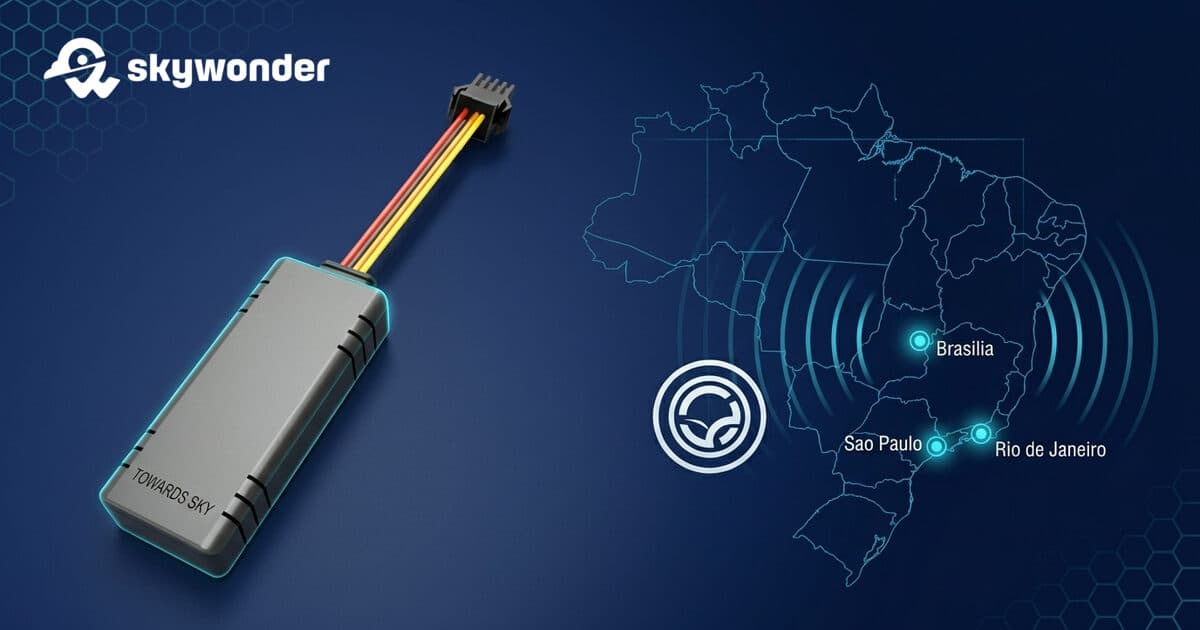
Short answer: An ANATEL certified GPS tracker is a cellular tracking device that has passed Brazil's mandatory telecom homologation under Lei 9.472/1997 and Resolucao 715/2019. Since 6 April 2025, ANATEL only certifies devices that support 4G or higher, so 2G-only units can no longer be homologated. Selling or importing a non-homologated tracker risks customs seizure and heavy fines. Homologation must be held by a Brazilian CNPJ entity.
Every week, a Brazilian distributor asks us the same thing: "can I just import these trackers, or do I need ANATEL first?" The short version is that an ANATEL certified GPS tracker is not optional in Brazil, it is the law. If your device has a cellular modem, it emits radiofrequency, and Brazil regulates it accordingly.
We have been on the manufacturer side of that conversation since 2011. SKYWONDER ships GPS trackers, 4G dashcams, and the Traqcare platform to 100+ countries, over 20 million units to date. This guide is the one we wish we could hand every new Brazilian partner before their first purchase order: what homologacao ANATEL is, the 4G rule that changed everything in 2025, what non-compliance costs, and how to import units that clear customs cleanly.
What is ANATEL homologation, and why does every GPS tracker need it?
ANATEL homologation is Brazil's mandatory type-approval for any device that emits radiofrequency, and a cellular GPS tracker is squarely in scope. ANATEL, the Agencia Nacional de Telecomunicacoes, was created by Lei no 9.472/1997, the country's General Telecommunications Law (Planalto, Lei 9.472/1997). That law bars the use of RF-emitting equipment that ANATEL has not certified.
Here is the simple version. Your tracker has a cellular modem. A cellular modem is a radio transmitter. Radio transmitters need ANATEL's stamp before they can be sold, imported, or switched on in Brazil. There is no informal path around it.
The rules that govern the process sit in ANATEL Resolucao no 715/2019, the conformity-assessment and homologation regulation (RACT), updated by Resolucao no 780/2025 (ANATEL, Resolucao 780/2025). Under this framework, telecom products are grouped into categories. A GPS tracker with a SIM falls under Category II, the class for equipment that uses the radioelectric spectrum. The category sets your test scope and renewal cadence. It does not change the basic answer: yes, you need homologation.
According to Lei 9.472/1997, Brazil prohibits the use of radiofrequency equipment without certification issued or accepted by ANATEL. A cellular GPS tracker contains a radio transmitter, so homologacao ANATEL is legally mandatory before a unit can be imported, sold, or activated in Brazil (Planalto, Lei 9.472/1997).
At SKYWONDER, we field this question from Brazilian distributors almost every week, and the confusion is understandable. Buyers often assume an FCC or CE mark carries over. It does not. Brazil runs its own regime, and foreign certificates are treated as reference material, not as a substitute. If you want to review our full range before you evaluate compliance, our GPS tracker product line is a good starting point.
Get the GX3 Brazil spec sheet
See the exact bands, voltage, and cut-off specs Brazilian distributors ask us for, plus our ANATEL documentation overview.
Get the GX3 Brazil Spec SheetWhich trackers can you legally import into Brazil in 2026?
Only 4G or higher. Since 6 April 2025, ANATEL certifies exclusively devices that support at least 4G, a rule tied to ANATEL Act 14430 (Telecompaper, 2025). Devices homologated before that date keep their existing certificates, but you cannot homologate a new 2G-only tracker anymore.
This one rule reshapes the entire Brazil buying decision for 2026. If you are sourcing fresh inventory, a 2G-only SKU is a dead end. It might clear on an old certificate held by someone else, but you cannot certify it yourself, and you are buying into a network that is being switched off.
How large is the legacy problem? Industry estimates put roughly 12 million of about 20 million tracking and payment devices in Brazil still running on 2G or 3G (IoT Business News, 2025). That is a migration wave, and it is a sales opportunity for any distributor holding compliant 4G stock when carriers pull the plug.
The single most important 2026 sourcing rule for Brazil is simple: buy 4G LTE. Since 6 April 2025, ANATEL no longer certifies 2G-only or 3G-only devices, and an estimated 12 million of 20 million tracking and payment units in Brazil still run on legacy networks that carriers are winding down (Telecompaper, 2025; IoT Business News, 2025).
That is why our current Brazil line-up is 4G-first. The GX3 4G vehicle tracker runs on 4G LTE with GPS and BeiDou dual-mode positioning, a wide DC 9-95V input, and a remote fuel and power cut-off relay. For distributors who want WiFi positioning as well, the GX7 4G tracker adds it. Fleets standardizing on a single wired unit often pick the GT10 4G tracker or the compact H9 4G tracker.
How do you homologate a GPS tracker in Brazil?
The ANATEL processing step alone takes 16 to 30 calendar days, and it is free, per the official government service page (gov.br, 2026). But that window covers only the administrative approval. Lab testing and OCD documentation happen first and add weeks. Here is the full path.

Appoint a Brazilian representative. Only a legal entity with a CNPJ can hold an ANATEL homologation. A foreign manufacturer works through a local subsidiary or an importer of record, who becomes jointly and severally liable for compliance.
Test at an ANATEL-accredited lab in Brazil. Foreign FCC or CE reports are reference only. A Designated Certification Body (OCD) manages the certification against local test requirements.
Register the product identifiers. Customs release of RF devices depends on an active ANATEL homologation number plus a GS1 Brasil EAN code tied to the CNPJ holder.
Submit through Mosaico. Applications go through ANATEL's Mosaico and SCH system online. Budget the 16 to 30 day ANATEL processing window here.
Track the renewal. For a Category II tracker, the underlying Certificate of Conformity renews every two years, while the homologation ID itself remains valid indefinitely.
Who should own this work? For most distributors, the smart move is to partner with a manufacturer that already understands the documentation, rather than treating homologation as a solo research project. When we ship into Brazil, we prepare the technical files our clients' OCDs ask for, which cuts the back-and-forth. Talk to our export desk through the SKYWONDER contact page if you want to see what that looks like.
What does selling a non-homologated tracker actually cost?
More than the certification would have. Selling, distributing, or using a non-homologated RF product in Brazil is an administrative violation that can trigger fines and equipment seizure, with penalties ranging from a few hundred reais up to tens of millions depending on the entity and the severity (Yes Certificacoes, citing Art. 173 Lei 9.472/1997, 2025). Sources put the ceiling between R$ 30 million and R$ 50 million depending on which sanction methodology applies.
Enforcement is not theoretical. In a campaign that began on 26 May 2025, ANATEL seized more than 3,000 non-homologated products and levied fines exceeding R$ 7 million, including a single penalty of R$ 6.78 million on a major marketplace (ib-lenhardt, ANATEL regulatory news, 2025). Customs is the first choke point. Without an active homologation number, RF shipments can be blocked or seized before they ever reach a warehouse (ib-lenhardt, market access and import rules, 2025).
According to ib-lenhardt's reporting on ANATEL enforcement, a 2025 operation seized over 3,000 non-homologated products and issued fines above R$ 7 million, including R$ 6.78 million against one marketplace. For a GPS tracker importer, homologation is effectively a prerequisite for customs clearance, not an optional quality badge (ib-lenhardt, 2025).
So the real cost of skipping homologacao ANATEL is not the fine you might dodge. It is the seized container, the frozen cash, and the distributor relationship that never recovers.
Why this matters if you are ready to buy
You are not researching whether to enter Brazil. You are deciding which supplier will not get your first container stuck in customs. A manufacturer that ships 4G-compliant hardware and hands you clean technical documentation removes the single biggest risk in a Brazil GPS tracker import: a non-homologated unit that never clears the port. Ask any prospective supplier for their ANATEL documentation before you place a purchase order, not after.
How big is the Brazil GPS tracker opportunity?
Big, and growing double digits. Berg Insight reports that the installed base of active fleet management systems in Latin America will grow from about 8.3 million units in 2024 to 16.6 million by 2029, a 15.0% compound annual growth rate, with penetration climbing from 20.9% to 40.0% (Berg Insight, Fleet Management in Latin America, 2025). Brazil is the region's anchor market.

For a Brazil-specific figure, Verified Market Research sizes the country's vehicle tracking system and software market at USD 2.23 billion in 2024, forecast to reach USD 5.59 billion by 2032 (Verified Market Research, 2025). Globally, Mordor Intelligence values the vehicle tracking market at USD 29.60 billion in 2025, heading to USD 60 billion by 2030 at a 15.18% CAGR (Mordor Intelligence, 2025).
What drives it? Theft, mostly. Brazil's national public-safety yearbook reports 344,596 vehicles stolen or robbed in 2024, roughly one every 1.5 minutes, and vehicle theft (furto) rose 121% over the decade from 2014 to 2024 (Forum Brasileiro de Seguranca Publica, 19o Anuario, 2025 edition). When a vehicle is stolen every 90 seconds, tracking stops being a nice-to-have.
Here is the compliance picture in one table your team can extract quickly.
ANATEL homologation for a GPS tracker, at a glance
Homologation factor | What Brazil requires |
|---|---|
Legal basis | Lei 9.472/1997 and ANATEL Resolucao 715/2019 (updated by 780/2025) |
Device category | Category II (uses the radioelectric spectrum) |
Who can hold it | A Brazilian legal entity with a CNPJ |
Where testing happens | An ANATEL-accredited lab in Brazil, via an OCD |
ANATEL processing time | 16 to 30 calendar days (administrative step only) |
Certificate renewal | Every 2 years for Category II |
Penalty for skipping | Fines up to tens of millions of reais, plus seizure |
What makes a tracker Brazil-ready? The GX3 and the compliance checklist
Four things, and 4G is only the first. A Brazil-ready GPS tracker in 2026 needs 4G LTE support (a hard ANATEL requirement since April 2025), a path to homologation, hardware that survives Brazilian fleet conditions, and a manufacturer who backs the documentation. Miss any one and you have inventory you cannot clear or cannot sell.
Our GX3 4G vehicle tracker was built with exactly this list in mind. It runs 4G LTE with GPS and BeiDou dual-mode positioning, accepts a wide DC 9-95V input (so it fits everything from motorcycles to trucks), and includes a remote fuel and power cut-off relay for recovery scenarios. Intelligent ACC detection and a 3-axis sensor handle trip and tow detection, and it operates from -20 to 75 degrees Celsius.
Our finding (SKYWONDER 2026 Brazil order data, first-party)
Across our Brazil-bound purchase orders in 2026, roughly 90% now request 4G vehicle trackers and only about 10% are still 2G-only. That split has widened sharply since the April 2025 certification change. The migration is not coming, it is already the shape of our order book.
Use this checklist when you evaluate any tracker for the Brazilian market:
Connectivity: 4G LTE at minimum. Confirm the bands match Brazilian carriers.
Homologation path: ask the manufacturer for ANATEL documentation and test-file support in writing.
Power range: wide-voltage input covers mixed fleets (cars, trucks, motorcycles).
Recovery features: a cut-off relay and geofence for theft response.
Environmental spec: an operating range that handles Brazilian heat.
Positioning redundancy: GPS plus BeiDou or GLONASS for dense-urban accuracy.
If you need something outside the wired vehicle category, the W07 portable 4G tracker covers asset and portable use cases, and our broader product catalog lists OBD, personal, and dashcam options. For a tailored recommendation, just contact our team.
Here is a quick reference for the 4G SKUs distributors ask about most for Brazil.
SKYWONDER 4G SKUs commonly specified for Brazil
SKU | Type | Connectivity | Standout feature |
|---|---|---|---|
GX3 | Wired vehicle | 4G LTE, GPS/BeiDou | Fuel/power cut-off, 9-95V |
GX7 | Wired vehicle | 4G LTE, WiFi positioning | Added WiFi location |
GT10 | Wired vehicle | 4G LTE | Fleet standardization |
H9 | Compact vehicle | 4G LTE | Small form factor |
W07 | Portable/asset | 4G LTE | No fixed install needed |
Ready to move on Brazil?
Get the GX3 Brazil spec sheet with bands, voltage, and cut-off details, plus our ANATEL documentation overview. Quoted direct from the factory.
Get the GX3 Brazil Spec SheetSKYWONDER B2B, OEM & white-label terms
MOQ: Flexible for standard SKUs. OEM and white-label programs available. Contact for details.
Lead time: Production and dispatch windows confirmed per order at quotation.
Payment terms: 30% deposit / 70% before shipment. LC at sight on larger orders.
Warranty: Manufacturer warranty on all hardware, with DOA replacement.
Certifications: CE, FCC, RoHS, and ISO 9001:2015, with ANATEL documentation support for Brazil-bound orders.
OEM tiers: Printed logo, custom packaging, custom firmware, custom hardware, white-label Traqcare platform.
Shipping: FOB Shenzhen / Yantian, CIF and DDP available, direct shipping to 100+ countries.
Pricing: B2B and OEM pricing on request. We do not publish retail pricing.
Frequently asked questions
Does a GPS tracker really need ANATEL certification in Brazil?
Yes. A cellular GPS tracker contains a radio transmitter, and Lei 9.472/1997 prohibits using RF equipment without ANATEL certification. Homologation is mandatory before a unit can be imported, sold, or activated. Skipping it exposes you to customs seizure and fines up to tens of millions of reais (Planalto, Lei 9.472/1997).
Can I use my FCC or CE certificate to sell in Brazil?
No. Brazil runs an independent regime under ANATEL Resolucao 715/2019. Foreign FCC or CE test reports count only as reference material and cannot replace local testing at an ANATEL-accredited lab. You still need a Brazilian OCD to certify the product before homologation (MiCOM Labs, 2025).
Can a foreign manufacturer hold ANATEL homologation directly?
No. Only a Brazilian legal entity with a CNPJ can hold homologation. A foreign manufacturer works through a local subsidiary or an importer of record, who is jointly and severally liable for compliance. This is why choosing a manufacturer experienced with Brazil documentation matters (Yes Certificacoes, 2025).
Can I still import 2G GPS trackers into Brazil?
Not for new certification. Since 6 April 2025, ANATEL only certifies devices supporting at least 4G. Units homologated earlier keep their certificates, but you cannot homologate a new 2G-only tracker, and 2G networks are being wound down. For new stock, buy 4G LTE (Telecompaper, 2025).
How long does ANATEL homologation take?
The ANATEL processing step takes 16 to 30 calendar days and is free (gov.br service page, 2026). That window covers only the administrative approval. Lab testing and OCD documentation come first and add weeks, so plan for a total timeline measured in weeks to a few months.
How often does the certification need renewal?
For a Category II device like a cellular GPS tracker, the underlying Certificate of Conformity renews every two years. The homologation identifier itself stays valid indefinitely once issued, so the recurring task is the biennial certificate renewal, not a fresh homologation (MiCOM Labs, 2025).
What is homologacao ANATEL in plain terms?
Homologacao ANATEL is Brazil's official type-approval confirming that a telecom device meets national technical and safety rules. For a GPS tracker, it certifies that the cellular radio complies with ANATEL standards. It is the legal green light to import, distribute, and activate the device in Brazil.
About the author
Kumar Saurabh is the Head of Overseas Business of SKYWONDER Technology Co., Ltd., a Shenzhen-based GPS tracker, 4G dashcam, and fleet-platform manufacturer that has shipped 20+ million units to 100+ countries since 2011. He writes about manufacturing, B2B telematics, and international market access for tracking hardware. Connect on LinkedIn.
Related reading: Regional & Sourcing
Written by Kumar Saurabh
Kumar Saurabh leads platform and protocol engineering at SKYWONDER Technology Co., Ltd. (Shenzhen, founded 2011). With 15+ years in GPS hardware, telematics software and IoT systems, he writes about GT06 and JT/T 808 integration, the Traqcare platform, and how resellers build tracking businesses on factory-direct hardware.
Related Articles
View all
AIS-140 GPS Tracker Compliance: What Indian Fleet Operators Need to Know in 2026
A manufacturer's guide to AIS-140 compliance for Indian fleets: what a certified VLTD must include, the ARAI/ICAT certification path, state-empanelment traps, and the 2026 India compliance checklist.
Best 4G GPS Trackers for African Fleets in 2026 (Tested Across South Africa, Nigeria, Kenya, Ethiopia and Uganda)
A manufacturer's field guide to the best GPS tracker for Africa: 4G hardware picks, the 2027 2G sunset deadline, and country-by-country buying notes for South Africa, Nigeria, Kenya, Ethiopia and Uganda.
Stay Updated with GPS Tracking Insights
Get the latest articles, tips, and industry news delivered to your inbox.