
AIS-140 GPS Tracker Compliance: What Indian Fleet Operators Need to Know in 2026
A manufacturer's guide to AIS-140 compliance for Indian fleets: what a certified VLTD must include, the ARAI/ICAT certification path, state-empanelment traps, and the 2026 India compliance checklist.
Sam K. Martin
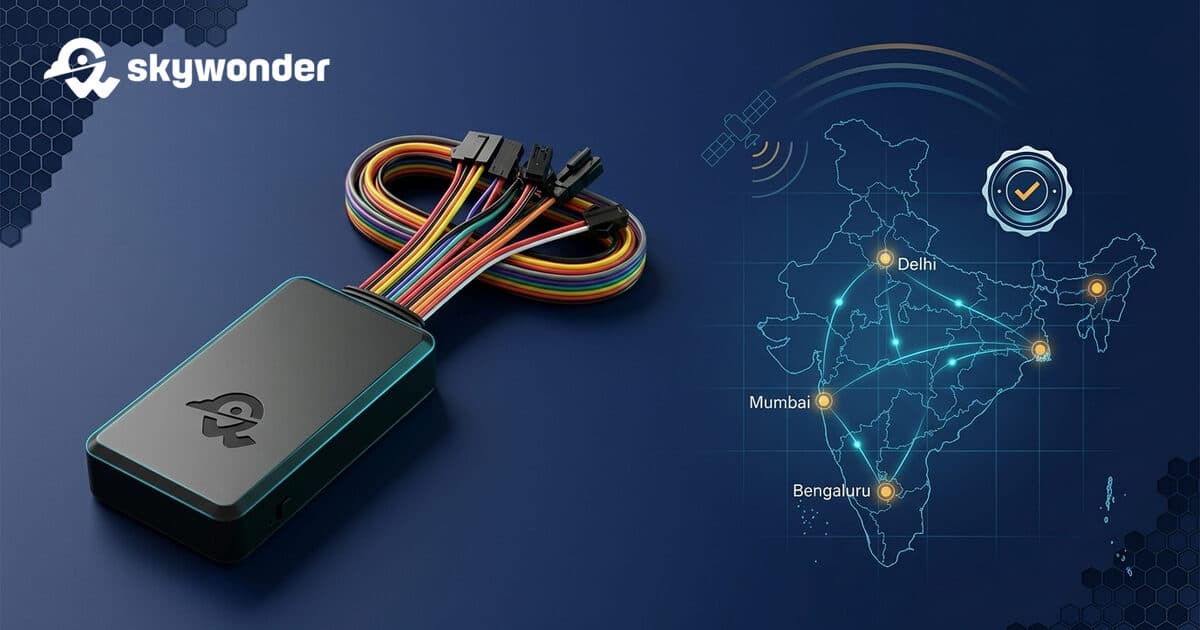
Short answer: An AIS-140 GPS tracker is a certified Vehicle Location Tracking Device (VLTD) that Indian public and commercial transport vehicles must fit by law. It needs NavIC/GNSS positioning, at least one hard-wired panic button, an embedded SIM, and live data links to a state backend. Compliance means passing ARAI or ICAT testing and empanelling with each state you operate in.
Last updated: 14 July 2026. By Sam K. Martin (B2B Partnerships Lead), with engineering notes from Kumar Saurabh. SKYWONDER Technology: manufacturer since 2011, 20M+ cumulative units shipped as of Q2 2026, partners in 100+ countries.
At SKYWONDER, we've shipped VLTD hardware into 100+ countries since 2011, and India is one of the most misunderstood markets we serve. Operators keep asking us the same thing: is any GPS tracker enough, or does an AIS-140 GPS tracker have to be something specific? The short answer is that it's very specific, and getting it wrong stalls vehicle registration at the RTO. This guide walks through the rules, the device spec, the certification path, and the state-by-state traps, from the people who actually build the boxes.
What is AIS-140, and which vehicles must comply?
AIS-140 is an Automotive Industry Standard, published by the Automotive Research Association of India (ARAI) on behalf of the Ministry of Road Transport and Highways (MoRTH), that defines Intelligent Transportation System requirements for public transport vehicles. In plain terms, it is the rulebook that says a commercial passenger or transport vehicle must carry a certified tracking device and an emergency button.
The legal teeth come from Rule 125H of the Central Motor Vehicles Rules, inserted through notification G.S.R. 1095(E) dated 28 November 2016 (MoRTH, 2016). That rule mandates a Vehicle Location Tracking (VLT) device plus one or more emergency buttons in public service vehicles. Devices registered on or after 1 January 2019 had to comply, and from 1 April 2018 they were required to support India's own NavIC (IRNSS) satellite system.
Let us define the key term. A VLTD (Vehicle Location Tracking Device) is a hardware unit that continuously reports a vehicle's position, speed, and status to a government-approved backend, and raises an alert when a panic button is pressed. A consumer GPS tracker records location. A VLTD reports it to the state, on the state's terms, in the state's format. That distinction is the whole game.
Which vehicles fall in scope? Broadly, transport vehicles under the Motor Vehicles Act:
Public service vehicles: buses, stage and contract carriages, taxis, and app cabs
National and state permit commercial vehicles
School buses and staff transport, where state rules extend the mandate
Vehicles carrying hazardous or dangerous goods
Private two-wheelers and personal cars sit outside the mandate. Some vehicle classes need only a VLT device with an emergency button, while full public passenger fleets need the complete AIS-140 VLTD with backend integration. The exact split is set by each state notification, so confirm against the state you register in.
Ready to shortlist compliant hardware?
The evaluation catalog: device-by-device certification, state-empanelment coverage, plus the OEM tier breakdown. No sales call required.
Request the AIS-140 Compatible Device DetailsWhy did India make AIS-140 GPS tracker compliance mandatory?
Road safety drove the mandate, and the numbers explain the urgency. In 2024, MoRTH recorded 1,77,175 road accident deaths across 4,87,707 reported accidents, a rise of about 2.5% over the previous year (MoRTH, Road Accidents in India 2024, 2026). In 2023 the figure was 1,72,890 deaths (MoRTH, Road Accidents in India 2023, 2024). That is roughly 485 lives lost every single day.

The second driver was women's safety. The AIS-140 panic-button program traces back to the Nirbhaya Fund, the safety corpus set up in 2013 after the December 2012 Delhi case. MoRTH's state-wise vehicle-tracking scheme for safety and enforcement was advanced under that aegis, which is why the emergency button is not optional decoration. It is the point.
Those panic alerts have somewhere to go. When a passenger presses the button, the VLTD fires an emergency packet that routes to the state backend and into the Emergency Response Support System, India's single emergency number 112, which went live in February 2019 and now operates across all 36 states and union territories (ERSS-112, 2019). A compliant AIS-140 GPS tracker is one node in a national emergency-response network, not a standalone gadget.
According to MoRTH's own 2024 reporting, overspeeding remains the dominant cause of fatal crashes, which is exactly the behaviour continuous VLTD telemetry is designed to surface for enforcement. For a fleet operator, that reframes compliance: the same data the state wants for safety is the data you want for driver management.
What does an AIS-140 compliant VLTD actually require?
An AIS-140 VLTD is a hardware unit that must satisfy a defined feature set before ARAI or ICAT will certify it. The headline requirement most importers underestimate is NavIC: the device must support India's IRNSS constellation, not just GPS. Below is the working specification our engineering team builds to. Treat the numeric values marked with an asterisk as the widely implemented industry baseline, and confirm the exact clause against your purchased copy of the AIS-140 standard before you sign a supply contract.
AIS-140 VLTD working specification
Requirement | AIS-140 expectation | Why it matters |
|---|---|---|
Positioning | GNSS with mandatory NavIC / IRNSS support (GPS, GLONASS, Galileo optional) | NavIC support is the India-specific gate; GPS-only devices fail certification |
Emergency button | At least one hard-wired physical panic button (software buttons do not qualify) | Triggers a priority alert to the state backend and ERSS-112 |
SIM | Embedded SIM (eSIM), commonly with dual-operator fallback | Survives network gaps and tamper attempts on removable SIMs |
Backend links | Transmit to a minimum of two IP addresses (state PVT backend plus emergency channel) | Separates routine position data from safety alerts |
Battery backup | Internal backup, typically rated around 4 hours* | Keeps reporting if main power is cut |
Enclosure | Dust and splash resistance, commonly IP65* | Survives Indian road, dust, and monsoon conditions |
Reporting interval | Configurable, often 5 seconds moving to 10 minutes idle*, alerts sent immediately | Balances live tracking against data cost |
Configuration | Over-the-air (OTA) configuration and firmware update | Lets the state push parameter changes remotely |
*Baseline values commonly implemented across the industry; verify the exact figure against the current AIS-140 standard document.
Reading a spec table is not the same as knowing what to check when a sample lands on your desk. Here is the shortlist we hand our own Indian distributors before they commit to a purchase order:
Does the ARAI certificate name this exact model, and is it current on the ARAI list?
Is NavIC support in silicon, or a firmware claim that has not been tested?
Is the emergency button hard-wired and rated for the vehicle's duty cycle?
Can the device push data to two backend IPs at once without dropping alerts?
Is there a documented over-the-air path for state-mandated parameter changes?
Our finding: In our own type-approval trials, the most frequent failure was not the panic button or the enclosure. It was NavIC handled in firmware rather than in the positioning chipset, which passes a bench demo and then fails a real certification test. We now spec the constellation at silicon level for every AIS140 compliant models.
How do you get an AIS-140 GPS tracker certified?
Certification is a defined sequence, not a single stamp, and it runs through agencies notified under CMVR Rule 126, principally ARAI and ICAT (the International Centre for Automotive Technology). Skipping any step leaves you with a device that works technically but cannot register a vehicle legally. Here is the path in order:
Design to the standard. Build the VLTD against the full AIS-140 feature set, with NavIC, the hard-wired panic button, eSIM, and dual-IP backend support engineered in from the start, not bolted on.
Type approval testing. Submit a sample to ARAI or ICAT for type approval under CMVR Rule 126. The agency tests positioning, emergency-alert behaviour, environmental resistance, and backend communication.
Conformity of Production (CoP). Secure and maintain CoP certification, the ongoing quality assurance that every mass-produced unit matches the type-approved sample (ARAI CoP, 2026). CoP is annual, not one-and-done.
State backend empanelment. Register the certified device with each state transport department's VLTD backend so its data format is accepted. Several state backends were built with support from CDAC (Centre for Development of Advanced Computing).
Fitment and activation. Install in the vehicle, activate the eSIM, verify live data reaches the state portal and that a test panic alert lands, then complete RTO registration.
A useful sanity check: ARAI publishes a live list of AIS-140 certified VLT devices, current as of 29 January 2026 (ARAI, 2026). If a supplier's model is not on that list, its certification claim is unverified. We tell buyers to check the list before anything else, because it settles the argument in thirty seconds.
Why this matters for evaluation-stage fleet buyers
If you are comparing vendors right now, the certificate is table stakes, not a differentiator. Every serious supplier can show an ARAI number. What separates them is state empanelment coverage and how fast they turn around a new state. A device certified but empanelled in only three states will strand you the moment you win a route in a fourth. Ask for the empanelment map, not just the certificate.
Why state-level empanelment trips up importers
State empanelment, not central certification, is where most compliance projects stall. A device can hold a valid ARAI certificate and still be rejected at an RTO because it is not registered with that particular state's VLTD backend. Implementation, data formats, portals, and deadlines all vary by state (MoRTH VTS Guidelines, 2019).
Each state runs its own portal and its own rules. Odisha, Haryana, and West Bengal, for example, each operate separate VLTD backends with their own standard operating procedures. A commonly cited example deadline had commercial vehicles registered before January 2025 complying by 31 March 2026, but that figure is state-specific, so verify it for every state you actually operate in rather than assuming a national date.
This is the part outsiders get wrong, and we learned it the hard way. When we first supported an Indian distributor across multiple states, we assumed one certified firmware image would sail through everywhere. It did not. Each new state backend needed protocol tuning, endpoint configuration, and a fresh round of test-alert validation before data was accepted. We now budget integration time per state, and we tell distributors to do the same. A realistic multi-state rollout is a phased project, not a single switch-on.
The practical takeaway is simple. When you evaluate an AIS-140 GPS tracker vendor, weight their state coverage and their integration turnaround at least as heavily as the hardware spec. The box is the easy part.
How big is the India fleet telematics opportunity?
The India fleet and vehicle-tracking market is large and growing at a double-digit clip, though the exact size depends on which research firm you read. As of 2024, IMARC valued India's vehicle-tracking market at about USD 2.3 billion, projecting roughly USD 5.42 billion by 2030 at a 15.2% CAGR (IMARC, 2024). Separately, MarkNtel Advisors put the India fleet telematics platforms market near USD 1.68 billion in 2025 with growth around 13% CAGR through 2032 (MarkNtel Advisors, 2025).

Treat every one of those figures as an estimate from a commercial research house, because the numbers diverge widely, with CAGRs ranging from roughly 10% to 25% across firms. The honest read is a range, not a single point. What is not in dispute is direction: regulation is pulling a large installed base of Indian commercial vehicles into mandatory telematics, and that demand does not switch off.
For a distributor or OEM buyer, the strategic point is that AIS-140 is a recurring, regulation-driven line of business. Vehicles keep getting registered, devices need replacement and CoP-compliant restocking, and every new route into a new state reopens the empanelment question. That is a durable channel, which is exactly why picking a manufacturer partner who can keep pace with certification matters more than shaving a few rupees off unit cost.
How SKYWONDER builds for AIS-140
We're a manufacturer, not a reseller, so our answer to AIS-140 starts at the chipset. Across our GPS tracker range, including models such as the GT10, GX3, and GX7, we spec NavIC support in silicon for India-bound units, hard-wire the emergency button, and design the dual-IP backend path in from the first schematic rather than patching it later. You can see the current lineup on our product range and pair devices with our Traqcare fleet platform.
Because we own the production line, we control the two things that decide an India project: certification status and change turnaround. When a state updates its backend protocol, a firmware fix doesn't wait behind a third-party supplier's roadmap. That vertical control is the whole reason we can support a distributor across several Indian states without the rollout stalling.
For B2B buyers weighing a partner, here is what we bring to the table:
B2B / OEM / white-label manufacturing and branding
MOQ and lead time: contact us for current B2B and OEM terms, we quote against your volume and state footprint
Warranty: standard manufacturer warranty on all VLTD hardware
Certifications: CE, FCC, RoHS, e-Mark (UN ECE R10 EMC for hardwired vehicle units), and ISO 9001 quality management, alongside the ARAI or ICAT approval path for India-specific models
Support: direct engineering contact for backend integration, not a ticket queue
One India-specific note worth stating plainly: AIS-140 and ARAI cover the transport VLTD mandate, but they aren't the whole cert story. Radio and import approval run separately through WPC ETA, BIS, and TEC, and once you rebrand a device under your own logo you become the responsible party for filing them. Confirm the full path with a local lab before an OEM run.
We don't publish retail pricing, because B2B and OEM terms depend on volume, configuration, and how many states you need empanelled. Tell us your footprint and we'll quote it. Manufacturer since 2011, 20M+ cumulative units shipped as of Q2 2026, 84 new reseller partners onboarded across 2025 and H1 2026, partners in 100+ countries.
Frequently asked questions
Is any GPS tracker AIS-140 compliant?
No. A generic GPS tracker records location, but an AIS-140 GPS tracker must be a certified VLTD with NavIC support, at least one hard-wired panic button, an embedded SIM, and live links to a state backend. It must pass ARAI or ICAT type approval and appear on ARAI's certified device list. Consumer trackers cannot register a commercial vehicle at the RTO.
Which vehicles need an AIS-140 GPS tracker in India?
Transport vehicles under the Motor Vehicles Act: public service vehicles like buses, taxis, and app cabs, national and state permit commercial vehicles, and, where state rules extend it, school buses and hazardous-goods carriers. Private cars and two-wheelers are exempt. The exact scope is set by each state's notification, so confirm against the state where you register.
What is the difference between ARAI certification and state empanelment?
ARAI or ICAT certification is central type approval confirming the device meets AIS-140. State empanelment is separate: it registers that certified device with a specific state's VLTD backend so its data is accepted. A device can hold a valid ARAI certificate and still be rejected at an RTO if it is not empanelled in that state. You need both.
Does an AIS-140 device have to support NavIC?
Yes. Since 1 April 2018, AIS-140 devices must support India's NavIC (IRNSS) satellite system, not GPS alone. This is the India-specific requirement that trips up imported trackers. At SKYWONDER we implement NavIC at the positioning-chipset level rather than in firmware, because firmware-only NavIC often passes a bench demo but fails a real certification test.
How long does AIS-140 certification take?
Timelines vary by agency workload and how ready your device is, so we avoid quoting a fixed number. The sequence is fixed though: design to the standard, type-approval testing at ARAI or ICAT, Conformity of Production certification, then per-state backend empanelment before fitment. Building compliance in from the chipset stage is the single biggest factor in a fast, predictable approval.
Why does the AIS-140 panic button matter so much?
The panic button links your fleet into India's national emergency network. When pressed, the VLTD sends a priority alert to the state backend and into ERSS-112, the country's single emergency number, live since February 2019. The program traces back to the Nirbhaya women-safety fund, so regulators treat the button as central, not optional. Software or app buttons do not qualify; it must be hard-wired.
Conclusion
AIS-140 compliance in 2026 comes down to three things: a genuinely certified VLTD with NavIC and a hard-wired panic button, a current ARAI or ICAT approval you can verify on the public list, and state-by-state empanelment for every region you operate in. Miss any one and vehicles don't register. The safety mandate behind it all isn't abstract: India lost 1,77,175 people to road accidents in 2024, and every compliant device is a node in the response network built to bring that number down.
If you're sourcing hardware, the fastest way to de-risk the project is to start from a device list that already carries certification and empanelment status. That's exactly what we maintain.
Get your compliance shortcut
The evaluation catalog: device-by-device certification, state-empanelment coverage, and the OEM tier breakdown for your volume.
Request the AIS-140 Compatible Model DetailsAbout the author
Sam K. Martin is B2B Partnerships Lead at SKYWONDER Technology Co., Ltd., a Shenzhen-based manufacturer of GPS trackers, dashcams, and the Traqcare fleet platform, with engineering notes on this post from Kumar Saurabh. Manufacturer since 2011, 20M+ cumulative units shipped as of Q2 2026, 84 new reseller partners onboarded across 2025 and H1 2026, partners in 100+ countries. SKYWONDER builds VLTD hardware to AIS-140, CE, FCC, RoHS, e-Mark, and ISO 9001 standards. Talk to our team directly at /contact.
Related Articles
View all
ANATEL-Certified GPS Trackers for Brazil: A 2026 Importer's Guide
A manufacturer's walkthrough of ANATEL homologation for GPS trackers: the 4G-only mandate, the certification process, fines, and how to import compliant units into Brazil.
Best 4G GPS Trackers for African Fleets in 2026 (Tested Across South Africa, Nigeria, Kenya, Ethiopia and Uganda)
A manufacturer's field guide to the best GPS tracker for Africa: 4G hardware picks, the 2027 2G sunset deadline, and country-by-country buying notes for South Africa, Nigeria, Kenya, Ethiopia and Uganda.
Stay Updated with GPS Tracking Insights
Get the latest articles, tips, and industry news delivered to your inbox.