
Samsara and Geotab Alternatives for Heavy Equipment Fleets
What Samsara and Geotab offer for heavy equipment, why contractors look elsewhere, how OEM AEMP feeds, hardware-agnostic platforms and white-label options compare, and a formula for licence versus owned-hardware cost.
Kumar Saurabh
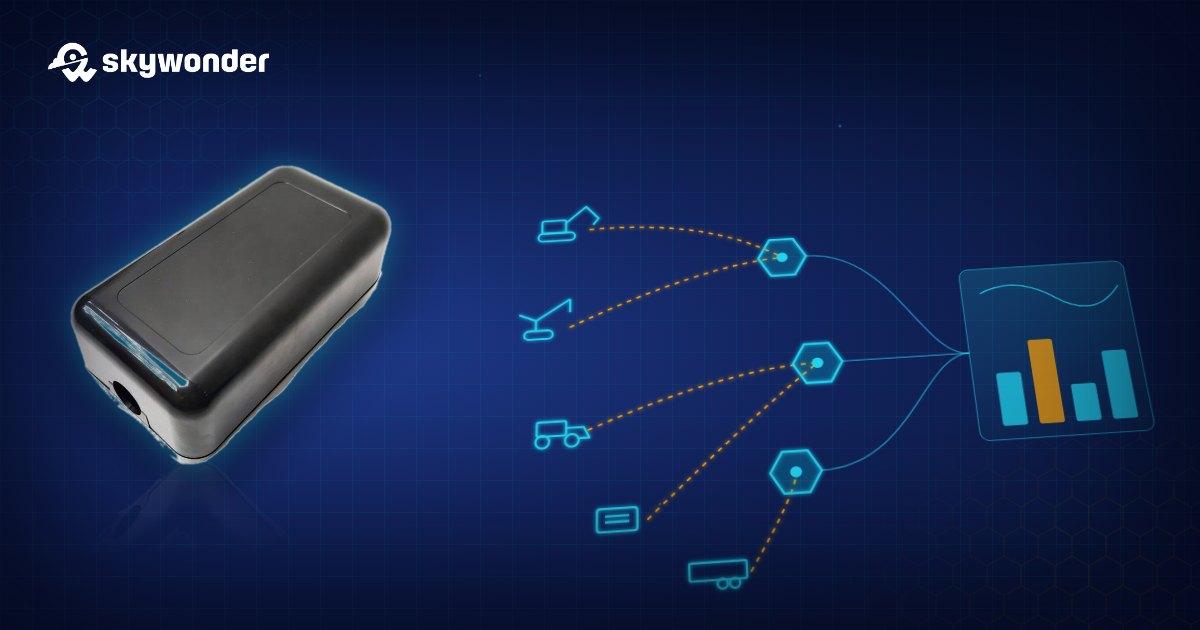
Short answer: There are three realistic alternatives to Samsara and Geotab for heavy equipment and construction fleets. You can use the OEMs' own telematics through AEMP 2.0, run a hardware-agnostic platform such as Wialon, Navixy or Traccar with trackers you own, or use a local reseller's white-label platform running factory-direct trackers.
AEMP 2.0 is the data standard of the Association of Equipment Management Professionals, published as ISO/TS 15143-3:2020. The right choice depends on how mixed your fleet is, which engine data you need, and whether you want a multi-year licence or hardware you own.
Last updated: 26 November 2026. By Kumar Saurabh, CTO at SKYWONDER, which makes GPS trackers and the Traqcare tracking platform in Shenzhen.
Geotab is "clearly in the lead" in North America, with several million subscribers, according to Berg Insight via the IoT M2M Council. Berg counted about 19.2 million active fleet management systems in North America at the end of 2024 and expects 33.2 million by 2029 (Computer Weekly).
Berg's figures cover all fleet systems, not only machines, but they show how much of the market the large platforms hold. Construction contractors with mixed or older fleets, and dealers who want their own brand, look for other ways to run fleet management. We make trackers and a white-label platform, so we are one of the alternatives in this article.
What does Samsara offer for heavy equipment?
Samsara's equipment monitoring page lists three gateway types. An Unpowered Asset Gateway provides "location tracking for unpowered equipment with long-lasting lithium batteries". A Powered Asset Gateway + provides "standard monitoring for engine diagnostics", and there is also a trailer gateway.
The page names generators, light towers, forklifts, skid steers and excavators among the powered equipment it tracks. It also offers "OEM telematics integrations that capture rich equipment diagnostics without installing aftermarket hardware".
The Powered Asset Gateway + page shows how the hardware reads engine data. A 9-pin cable pulls engine diagnostics over CAN (controller area network, the machine's internal data bus) from non-Caterpillar equipment. A separate 9-pin Caterpillar connector does the same on Cat machines.
The unit runs on LTE Cat M1, a low-power LTE category for connected devices. It is rated IP67 and IP69K, and it keeps logging to flash memory when there is no signal.
The same page says the gateway "requires AG Powered license". That licence "includes hardware, cloud software, cables, ongoing firmware updates, cellular data connectivity, and support", with discounts for volume and multi-year terms.
In practice you subscribe to a bundle, with the hardware priced inside the licence.
What does Geotab offer for heavy equipment?
Geotab's main heavy-equipment feature is its AEMP integration. It brings AEMP 2.0 data from the machine's factory telematics into myGeotab "for a singular view of all assets".
Because the data comes from the OEM, Geotab lists "no device hardware or installation costs" for those machines. Its page links AEMP dataset documents for Caterpillar, John Deere, Komatsu and Kubota. It says it is "in the process of expanding" its list of off-road partners.
Geotab is also open about the limit. Its off-road press release says "not all heavy equipment OEMs utilize the AEMP 2.0 standard", so fleets may need a third-party telematics device on those machines.
Why do construction contractors look for a Samsara or Geotab alternative?
- Contract model. A licence that bundles hardware, data and software suits a company that wants one bill and one supplier. A small contractor or rental yard may prefer to own the trackers and pay only for the platform. Some run the platform themselves.
- Mixed and older fleets. Half the fleet may be older machines, small brands, compressors and attachments. On those machines the job becomes fitting aftermarket trackers.
- Region and support. Contractors in Africa, Latin America, the Middle East and South Asia want local installation, local SIMs and support in their language and time zone. This matters most where neither platform has a local partner who installs and supports it.
- Own brand. Tracking resellers and dealers want to sell the service under their own name. A white-label GPS tracker range lets them brand the hardware side as well as the software.
How do the alternatives compare?
The table includes Samsara and Geotab for reference.
| Option | Hardware | Engine and idle data | Contract model | Own brand | Best for |
|---|---|---|---|---|---|
| Samsara | Samsara gateways, included in the licence | CAN engine diagnostics via gateway cables; OEM integrations | Licence bundle (hardware, software, data, support) | Not published | Fleets wanting one supplier for vehicles, equipment, video and safety |
| Geotab | Geotab devices or none (AEMP) | AEMP 2.0 from supported OEMs; devices elsewhere | Subscription | Not published | Fleets with many AEMP-capable machines from large OEMs |
| OEM portals / AEMP only | Factory-fitted | Engine hours, idle, fuel from the machine | Sold with the machine or through the dealer | No | Single-brand fleets of newer machines |
| Hardware-agnostic platform (Wialon, Navixy, Traccar) | Trackers you buy and own, from many makers | ACC, inputs and CAN data, depending on the tracker | Platform fee and SIM data per unit; Traccar is open source and can be self-hosted | Varies by platform | Integrators and fleets that want to choose hardware freely |
| White-label + factory hardware (Traqcare) | Trackers you or your reseller own | ACC time; RS485 sensors such as fuel level on the H8; no CAN data | Hardware bought once; platform fee and SIM data per unit under the reseller's terms | Yes: logo, colours, domain and apps | Resellers and dealers, and the contractors they serve |
Our equipment trackers do not read CAN or J1939 engine data (J1939 is the CAN message standard for heavy-duty engines); our C31 reads OBD-II data, but only on cars and light vans. Engine hours come from ignition (ACC) time, where ACC is the ignition-switched power line.
ACC counts key-on time even with the engine off, so it can read higher than the hour meter. Compare both during the pilot before you set service intervals from platform hours.
If you need fault codes or fuel burn from the engine computer, use OEM data, a CAN-reading tracker on an open platform, or one of the big platforms. See also our comparison of white-label GPS tracking platforms.
Licence bundle or owned hardware: how do you compare the cost?
Prices vary too much by region, volume and contract to quote, so use your own quotes and these variables:
- N = number of machines
- Y = contract length in years
- I = installation cost per machine (assumed equal in both models unless you adjust as below)
- L = bundled licence fee per machine per month
- H = one-off hardware cost per machine in the owned model (hardware only)
- P = platform fee and SIM data per unit per month in the owned model, plus your own support and labour cost per machine per month
- R = replacement units and reinstallation when units fail, per machine over the term in the owned model
Bundled cost = N × (I + L × 12 × Y). Owned cost = N × (I + H + R + P × 12 × Y). R grows with the term, so estimate it for the length of contract you are testing.
If installation costs the same in both models, I cancels out. The owned model is then cheaper once Y > (H + R) ÷ (12 × (L − P)), which only has an answer when P is lower than L.
If your installer charges a different price, add your installer's price minus the bundled vendor's installation price (a negative number if yours is cheaper) to the top of that fraction.
Count your own time in P, such as calls about offline units and swapping failed ones. The bundled licence includes support, and the bundled model is easier when you want hardware refreshes, connectivity and support handled by one supplier.
SIM data is a small part of P for most trackers. A car reporting every five minutes uses about 10 to 30 MB a month, as our guide to GPS tracker data consumption explains.
Worked example
Suppose your quotes give H = 18L and P = L/3. These ratios keep the arithmetic simple; they are not typical prices.
Assume installation costs the same in both models, and R = 0 for now. Per machine, the owned model then costs I + 18L + 4LY and the bundled model costs I + 12LY.
The owned model is cheaper once Y > 18L ÷ (12 × (L − L/3)) = 18L ÷ 8L = 2.25. It breaks even at 27 months (2.25 years), and after that the gap grows by 8L per machine per year. With cheaper hardware, say H = 6L, break-even falls to 9 months.
A non-zero R moves break-even later, to Y = 2.25 + R ÷ (8L).
How do you choose the right option for your fleet?
- Count your AEMP-capable machines. If most of your fleet is newer Cat, Deere, Komatsu or Kubota equipment, an AEMP-first platform saves hardware. If most of it is not, plan to fit trackers.
- Decide what "idle" means for you. Excavators and pumps work standing still, so ignition and GPS speed alone cannot separate work from idle. Ask us which input on your model can take a work signal (hydraulic pressure switch or PTO); on the H8 the RS485 port carries sensors. Our equipment idle time guide covers ACC wiring and idle rules.
- Check the network on your sites. LTE Cat M1, LTE Cat 1 (a higher-speed category than Cat M1) and 2G behave differently in remote areas. Ask which bands and networks the device supports on your sites; 2G is being switched off in some countries.
- Read the end-of-term clauses. Who owns the devices after the contract ends? Can you export your history? Is there a fee to leave?
- Ask for a pilot on your own machines. Fit ten machines for a month, including your oldest and your most remote. Compare ACC hours from the platform with the hour meters.
- Check local support. Who installs, who replaces a failed unit, and how fast, in your region?
What happens to your trackers and data if you switch platforms later?
Switching touches three parts: devices, history and integrations. Check all three before you sign.
Devices. Ask a bundled vendor whether its gateways can be used after the contract ends. If not, leaving means new hardware on every machine. Owned trackers on an open protocol can be pointed at a new server by changing the server address and port.
Ask us whether your model can be re-pointed remotely, and for the command. The new platform must support the device's protocol, and ours are protocol-open: they run on Traccar, Wialon, Navixy and GPS-Trace as well as Traqcare.
Integrators can check the message format in our GT06 protocol guide.
History. Ask every provider, before you sign, how you export trips, engine hours, idle events and fuel data. Ask in what format, and whether there is a charge. Engine-hour history is what you use to plan services and negotiate resale, so it should leave with you.
Integrations. If your maintenance, ERP or job-costing software reads telematics data, check the API on both sides. Developers working with our devices can start from the developer page.
Some fleets report to a lender or rental partner as well as their own office. On Traqcare you can give that partner its own user account. The J11 stores a primary and a backup server address and switches to the backup if the primary fails; it does not send to both at once.
When are Samsara or Geotab the better choice?
We would point a buyer to Samsara or Geotab when the fleet is mainly in North America and mostly newer machines from AEMP-capable OEMs. The case is stronger if the company wants vehicle video, driver safety, equipment and maintenance from one supplier on one contract, where their scale and OEM integrations count.
An owned-hardware or white-label option fits better when the fleet is mixed and older. It also fits where you cannot get local installation and support for the big platforms, or when a reseller wants the customer relationship and the brand. Our hardware and the Traqcare platform are aimed at that case.
Farm fleets have the same mix of new and old machines. See the agriculture solution and our guide to GPS tracking for agriculture.
Which SKYWONDER trackers fit heavy equipment?
We split trackers into wired units for powered machines and battery units for unpowered equipment. The table shows what each product page states.
| Model | Network | IP rating | Inputs / outputs | Battery / standby | Mounting | Temperature / alarms |
|---|---|---|---|---|---|---|
| H8 | 4G; bands by version, ask us | Waterproof housing; no IP figure published | ACC (1 channel), relay output, optional TTL/RS485 (1 channel), Bluetooth | Machine power, 9–90 V DC | Wired | -20 to 70 °C operating |
| GX7 | 4G; bands by version, ask us | Not published | ACC (1 channel), relay output | Machine power, 9–90 V DC; 300 mAh backup battery | Wired | -20 to 70 °C; tamper, vibration and power-cut alarms |
| W09 | 4G Cat 1 (B1/B2/B3/B4/B5/B7/B8/B28/B66) with 2G fallback | Not published | Not published | 4,200 mAh primary cells (3 × CR123A, not rechargeable); up to three years at one report a day | Four magnets; mount sheltered; light-sensor tamper alert | -20 to 75 °C |
| W10 | 4G Cat 1; GPRS fallback | IP65 | Not published | 6,000 mAh rechargeable; standby not published, ask us | Magnetic | -30 to 80 °C; vibration alarm (must be armed) |
| Y8 | 4G (B1/B3/B5/B8, TDD B34/B38–B41); check your carrier | IP67 | Not published | 15,600 mAh with solar charging | Not published | -20 to 60 °C; Hall-effect removal alarm |
| GT76 | 2G or 4G version; ask which | Not published | Not published | 20,000 mAh; ask us for standby at your reporting interval | Five magnets | -20 to 75 °C; light-sensor removal alarm |
Machines with an ignition line
The H8 and GX7 are wired trackers for machines with an ignition line. They record ACC time; they do not read engine data from the CAN bus.
Their relay output allows a remote fuel or power cut for theft, used only when the machine is stopped.
The H8's RS485 port (a wired serial connection for sensors) can carry a capacitive fuel level sensor, calibrated per tank in Traqcare's fuel reports. More wired models are in vehicle GPS trackers.
Unpowered equipment and attachments
The W09 covers LTE-FDD B1, B2, B3, B4, B5, B7, B8, B28 and B66. That includes the US bands B2, B4 and B66 (but not B12), and B3, B7 and B8 used in Europe.
It has no B20, which many European networks use, and no B40, one of India's main bands. Ask for the band version for your country. Its spec has no IP rating, so mount it sheltered, for example inside a nose cone, toolbox or chassis box.
The W09's three-year standby assumes its default of one report a day, and it has a light-sensor tamper alert.
The Y8 covers LTE-FDD B1, B3, B5 and B8 and TDD B34, B38, B39, B40 and B41. It lacks B7 and B20, which many European networks rely on, and the B2, B4, B12 and B66 bands that US networks use. Ask us to confirm it works on your carrier before ordering.
The GT76 comes in 2G and 4G versions. Its product page lists the 2G build (850/900/1800/1900 MHz); where 2G is being switched off, order the 4G version and confirm its bands.
Small tools and materials
For small tools and materials on site, a battery tracker on every item rarely pays; look at a Bluetooth beacon instead. The H8 has Bluetooth, but ask us whether your version can read tags before you plan around it.
The full battery range is in asset trackers, and sensors and cables are in accessories.
What else should you plan before you buy trackers?
- Installation. We are a factory in Shenzhen and do not install on site. Wired units need a local installer or your reseller's technicians.
- SIM cards. SIM supply is the reseller's or fleet's choice; pick a carrier that covers your sites.
- Warranty and shipping. Devices carry a 12-month warranty on manufacturing defects. For lithium battery units, ask us for the UN38.3 test summary and MSDS.
Our guide to importing GPS trackers from China covers customs, paperwork and the questions to ask a factory.
What if you want to sell equipment tracking under your own brand?
The reseller programme puts your brand on the service. Traqcare's web dashboard and iOS and Android apps carry your logo, colours, app name and domain, and you set your own pricing to customers. Wildeny Berges, who has run a vehicle tracking business since 2008, wrote: "My operations have been simplified with their products and their technical support is highly qualified."
MOQ (minimum order quantity) is the smallest order a factory accepts for each model. Our terms: MOQ 50–100 units by product; white-label programme from 100 units.
Samples 3–10 units ship in 5–7 business days by express courier.
If your fleet is below our MOQ, start with samples of 3–10 units or buy through a local reseller; contact us about either.
If you are weighing whether to build your own platform instead, read build vs buy for white-label tracking platforms. If you are new to the business, start with how to start a GPS tracking business.
Frequently asked questions
What is the best alternative to Samsara for heavy equipment?
It depends on the fleet. For newer machines from AEMP-capable OEMs, Geotab's AEMP integration or Samsara's OEM integrations avoid fitting hardware. For mixed and older fleets, consider an open platform with owned trackers, or a white-label platform from a local reseller. These can cost less over several years and give ignition-time data, plus work time where a work signal can be wired, from machines with no factory telematics.
Is Geotab or Samsara better for construction equipment?
Geotab fits fleets with many AEMP-capable machines from large OEMs. Samsara fits fleets that want vehicles, equipment, video and safety in one licence bundle. Geotab brings AEMP 2.0 data from supported machines into myGeotab and needs a telematics device on machines whose OEM does not support AEMP 2.0. Samsara uses OEM integrations, plus its Powered Asset Gateway + on machines without them. Pilot both on your own machines before you choose.
Can I track heavy equipment without a monthly licence bundle?
Yes. You can buy trackers outright and pay a platform fee and SIM data per unit, plus your own support time. You can also self-host an open-source platform such as Traccar and pay for SIM data and your own server. The trade-off is that installation, hardware replacement and support become your job or your reseller's.
Does AEMP 2.0 work with every machine?
No. AEMP 2.0, formalised as ISO/TS 15143-3:2020, only works where the manufacturer supports it, and Geotab notes that not all heavy equipment OEMs do. AEMP data also needs the machine's factory telematics active, sometimes on a separate OEM subscription, and the fields vary by brand. Older machines, small brands, compressors, light towers and attachments need an aftermarket tracker.
Can SKYWONDER trackers be used with Wialon or Traccar instead of Traqcare?
Yes. Our devices are protocol-open and run on Traqcare, Traccar, Wialon, Navixy and GPS-Trace. Integrators who build their own software can start from our GT06 protocol guide. If you change platforms later, the server address can be changed on the device (ask us whether yours supports a remote command), as long as the new platform supports the device's protocol.
How do I measure idle time on an excavator with an aftermarket tracker?
Wire the tracker's ACC input to a switched ignition line. Then add a work signal so digging in place is not counted as idle. Ask us which input on your model can take a work signal (hydraulic pressure switch or PTO); on the H8 the RS485 port carries sensors. Set one idle rule for the whole fleet, for example ignition on and no work signal for more than five minutes.
Do I need a local installer for aftermarket equipment trackers?
For wired units, yes. We are a factory in Shenzhen and do not install on site, so wired trackers such as the H8 and GX7 need a local installer or your reseller's technicians. Magnetic battery units such as the W09, W10 and GT76 can be fitted by your own staff. Plan sheltered mounting where the spec has no IP rating.
What should a reseller check before offering heavy-equipment tracking?
Check five things: the inputs your customers need (ACC, digital inputs, RS485); the network bands in your country; the branding the platform can carry; the MOQ, sample time and warranty; and the local installer. Our guide to importing GPS trackers from China lists the questions to ask a factory.
Next step: send us your machine list (brands, models and years), and we will tell you which units need a tracker, which can use OEM data, and what we would fit for your plant fleet. Request a fleet review and samples, or message us on WhatsApp at +86 137 1964 3083.
Written by Kumar Saurabh
Kumar Saurabh leads platform and protocol engineering at SKYWONDER Technology Co., Ltd. (Shenzhen, founded 2011). With 15+ years in GPS hardware, telematics software and IoT systems, he writes about GT06 and JT/T 808 integration, the Traqcare platform, and how resellers build tracking businesses on factory-direct hardware.
Related Articles
View all
Equipment Idle Time Tracking: How Telematics Measures It and How to Cut It
How telematics measures idle time on excavators, loaders and other heavy equipment, what idle share is normal, OEM AEMP data versus aftermarket trackers, wiring that makes idle reports accurate, and how fleets cut idle time.
GPS Fleet Management System: The 2026 Buyer's Guide
Hardware, video, platform and SIM, what a GPS fleet management system is made of, how to size it at 10, 50 and 500 vehicles, which SKU fits which vehicle, and what really drives cost.
Stay Updated with GPS Tracking Insights
Get the latest articles, tips, and industry news delivered to your inbox.