
White Label GPS Tracking Platform in 2026: Build vs. Buy vs. Rebrand (With the Cost Math)
A GPS manufacturer compares the build, buy, and rebrand routes to a white label GPS tracking platform in 2026, with real cost math and the margin model resellers actually use.
Sam K. Martin
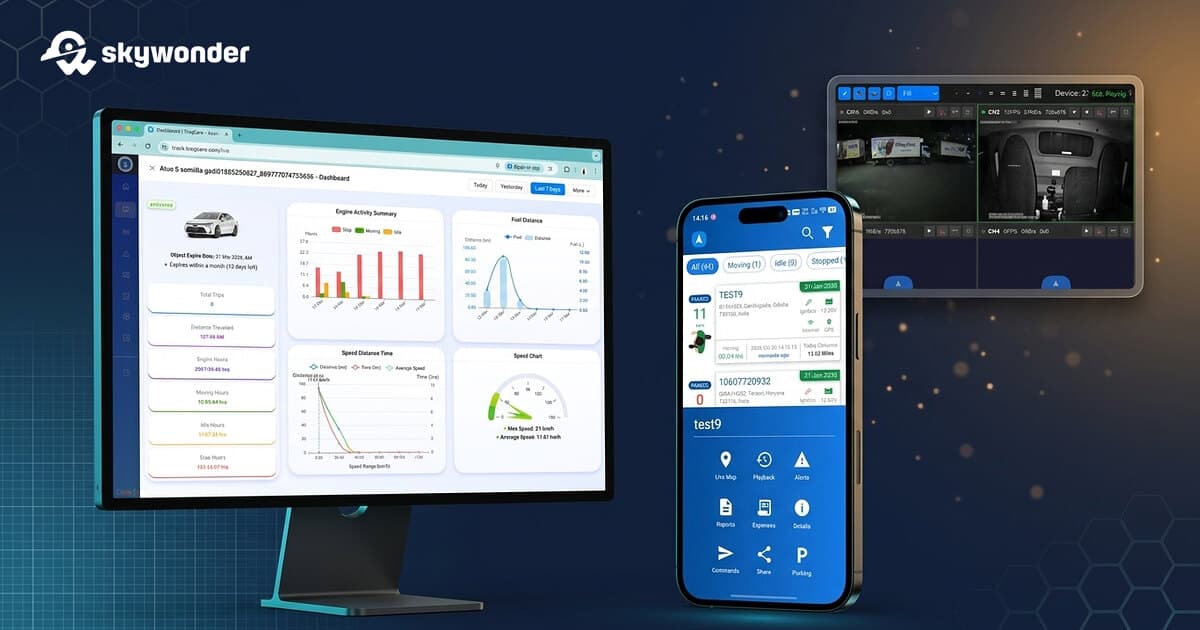
Short answer: A white label GPS tracking platform lets you sell vehicle tracking under your own brand without writing the software yourself. In 2026 you have three routes: build from scratch (6 to 12+ months, $100K to $1M), buy a generic SaaS license, or rebrand a manufacturer's platform like SKYWONDER Traqcare and ship hardware plus software from one source. For most resellers, rebranding wins on speed, margin, and support.
Last updated June 12, 2026. Written by Sam K. Martin, SKYWONDER (manufacturer since 2011, 20M+ units shipped, 100+ countries).
What Is a White Label GPS Tracking Platform?
A white label GPS tracking platform is fleet-tracking software, built by one company, that another company resells under its own brand, logo, and domain. You get the maps, alerts, reports, and mobile apps. Your customers see your name, not the developer's. It is the software half of a GPS business, and it is where the recurring revenue lives.
Think of it as the difference between manufacturing a phone and putting your label on a proven one. The hard engineering, parsing data from thousands of tracker models, drawing live maps, scaling servers, is already done. Your job is distribution and support, not protocol development.
The market backing this model is large and growing. The fleet management software market was valued at USD 32.36 billion in 2025 and is projected to reach USD 152.89 billion by 2034, a 18.9% CAGR, according to Fortune Business Insights. Software grows faster than hardware because every device you sell adds a subscription that compounds.
Definition, plainly: White-label means you rent a finished platform and dress it as your own. Private-label, rebrandable, and OEM platform all describe variations of the same idea. At SKYWONDER, our Traqcare platform is built to be rebranded from day one.
For the full software overview, see our GPS tracking software hub.
Build vs. Buy vs. Rebrand: Which Path Fits Your Business?
There are three honest ways to put a GPS platform in front of customers, and they sit on a spectrum from slow-and-expensive to fast-and-defensible. In 2026, custom software starts near USD 50,000 for the simplest builds and runs into the millions for full platforms, per Appinventiv. From our partnerships desk, the realistic range for a competitive fleet-tracking platform, multi-tenant, protocol-flexible, mobile-equipped, sits between USD 500,000 and USD 1 million before the first paying customer. Most resellers do not need that bill.
Here is the trade-off, synthesized from our own onboarding data across 100+ countries rather than copied from any vendor sheet.
Build vs. buy vs. rebrand: how the three paths compare
Factor | Build from scratch | Buy generic SaaS | Rebrand a manufacturer (Traqcare) |
|---|---|---|---|
Time to launch | 6 to 12+ months | Days to weeks | Days to weeks |
Upfront cost | $100K to $1M | Low, subscription | B2B / OEM pricing on request |
Hardware sourcing | Separate, your problem | Separate, often unsupported | Same supplier as software |
Device protocol support | You integrate each model | Limited, third-party | Native to the maker's devices |
Maintenance burden | Your DevOps team | Vendor handles | Manufacturer handles |
Brand ownership | Full | Varies, sometimes capped | Full: your logo and domain |
Margin control | High, after huge sunk cost | Squeezed by license fees | Strong: hardware plus SaaS |
Source: SKYWONDER 2026 partner-onboarding observations across 100+ countries. Build cost range reflects partners who attempted in-house GPS platform builds; Appinventiv (Build vs Buy Software 2026) confirms the wider "USD 50,000 to millions" range for custom software broadly.

See it on your own brand before you commit
We will spin up a Traqcare instance with your logo and domain so you can click through the exact platform your customers would use.
What Does It Cost to Build a GPS Tracking Platform From Scratch?
Building a GPS platform from zero is rarely worth it for a reseller. Basic custom builds start near USD 50,000 per Appinventiv, and from what we see at SKYWONDER's partnerships desk in 2026, a competitive fleet-tracking platform (multi-tenant, protocol-flexible, mobile-equipped) typically lands between USD 500,000 and USD 1 million before the first paying customer. And that is before the costs nobody quotes you upfront.
Why does the bill balloon? Because a tracking platform is not one app. It is a stack of specialized systems that each need engineers.
Device protocol parsing. Every tracker brand speaks a different binary dialect. Supporting even 20 models means writing and maintaining 20 parsers.
Live map infrastructure. Map tiles, geocoding, and routing carry recurring API fees that scale with every vehicle you add.
Real-time servers. Thousands of devices pinging every 10 seconds is a serious always-on workload, not a hobby server.
Mobile apps. iOS and Android builds, plus app-store maintenance, for the lifetime of the product.
Ongoing DevOps. Security patches, uptime, scaling. This never ends, and it is a salary line, not a one-time fee.
Our finding: across the partners we onboard, the hidden killer is not the first build. It is protocol maintenance. Our platform already speaks the language of 1,000+ device models as of Q2 2026, so a reseller inherits years of integration work on day one.
Here is the honest engineering callout, from a manufacturer that did build the stack: the software is the easy 20% to demo and the hard 80% to maintain. Buying or rebranding skips that 80%. For a closer look at the platform layer, see our white label GPS tracking software.
Why Do Most GPS Resellers Buy or Rebrand Instead?
Most resellers buy or rebrand because the market rewards distribution, not duplicate engineering. In 2026, the top five vendors hold only about half of North America's active fleet management units, with the rest fragmented across thousands of regional operators, according to Berg Insight. That fragmentation is the opening, and you do not capture it by spending a year coding.
The pull toward rebranding comes down to a few hard advantages:
Speed beats perfection. White-label SaaS lets you go from idea to launch in days instead of months, per Brilworks. You sell while builders are still hiring.
One throat to choke. When hardware and software come from the same maker, a device bug and a platform bug are one support ticket, not a fight between two vendors.
Compounding subscriptions. The global GPS tracking device market was valued at roughly USD 3.60 billion in 2025 and is projected to reach USD 14.78 billion by 2035, a 13.69% CAGR, according to SNS Insider. Every device you place adds recurring software revenue on top.
Focus. Your edge is knowing a local vertical, cold-chain, construction, motorcycles, not writing map-tile caching logic.
Why this matters for a BOFU buyer
If you are comparing platforms right now, the decision is not "which software has the most features." It is "which path gets me selling fastest with margin I control and support I can trust." Rebranding a manufacturer's platform collapses three vendor relationships (hardware, software, support) into one. That is the difference between launching this quarter and launching next year.
What Should a White Label GPS Tracking Platform Include in 2026?
A 2026-ready white label GPS tracking platform should include full rebranding, multi-tenant accounts, live tracking, and an open hardware path. The fleet telematics market is forecast to grow from USD 10.42 billion in 2025 to USD 21.95 billion by 2032, a 11.2% CAGR, according to MarketsandMarkets. Buyers expect more than a map.
When partners evaluate Traqcare, these are the capabilities that close the deal:
True rebranding: your logo, your domain, your app name, no "powered by" footer.
Multi-tenant architecture: one login that manages many customer accounts cleanly.
Real-time tracking and geofencing: live position, history, and virtual boundaries with alerts.
Recurring billing hooks: so your subscription revenue is simple to collect.
Native device support: the platform already speaks to the maker's full hardware range.
Open API: to plug into your CRM, your invoicing, or a customer's ERP.
White-label fleet tracking only works when the brand wall is total. A single leaked vendor logo undermines the trust you are charging for. This is why we treat rebranding as a core feature, not an upsell. Explore the stack on our GPS tracking software platform.
How Do White-Label GPS Margins Actually Work?
White-label GPS margins come from two stacked layers: a one-time hardware markup and a recurring software subscription that compounds every month. The recurring half is what turns a tracking business into an asset, because the fleet management software market is compounding at a CAGR of 18.9% through 2034 (Fortune Business Insights). The hardware gets you in the door. The subscription pays you for years.
Here is the model, with illustrative reseller numbers (your real figures vary by market, and SKYWONDER hardware is quoted on B2B terms, never public retail):
Hardware layer: you buy a tracker at B2B cost and resell it once at your markup. That covers acquisition and often the install.
Software layer: you charge the customer a monthly per-vehicle fee on the rebranded platform, while your platform cost stays a fraction of that. The spread is your recurring margin.
Compounding: unlike the one-time hardware sale, every active vehicle keeps paying. Month 12 income is the sum of every customer you have ever kept, not just this month's new sales.
From our onboarding desk: the partners who win treat the first hardware sale as near break-even and price the subscription for the long game. The reseller who obsesses over device margin alone plateaus. The one who builds a recurring base sells the company later at a multiple of that recurring revenue.
This is also why brand ownership matters so much. When the platform is fully yours, the recurring relationship is yours too, not a sublease from a software vendor who could change terms. Owning the brand wall protects the most valuable line on your balance sheet. See how the rebranding works on our white label GPS tracking software.
How Do You Launch a White-Label GPS Platform in 30 Days?
You can launch a white-label GPS platform in about 30 days by sequencing setup, branding, and a paid pilot in parallel. Because white-label tools deploy in days to weeks rather than the 6 to 12 months we typically see from SKYWONDER partners who attempted a from-scratch build (SKYWONDER 2026 partner-onboarding observation), the timeline bottleneck is your go-to-market, not the technology. Here is the sequence we walk new SKYWONDER partners through.
Week 1: lock your supplier and platform. Choose a manufacturer that ships both hardware and a rebrandable platform, then confirm device homologation for your market.
Week 2: brand the instance. Apply your logo, domain, and app name to Traqcare, and set your subscription pricing per vehicle.
Week 3: run a paid pilot. Put 10 to 20 units on one friendly customer's vehicles and capture a live ROI story.
Week 4: sell from proof. Use the pilot result as your opening line into the same vertical, then convert each install into a referral.
Notice what is missing: a development phase. That is the entire point of going white-label.
Which SKYWONDER Hardware Pairs With the Platform?
The right hardware depends on what you track, and a strong white label GPS tracking platform should support all of it natively. SKYWONDER builds the devices and the Traqcare platform together, so every SKU below reports into the same rebranded dashboard with no integration work.
Vehicle and fleet: wired trackers like the GT06-class GT10 and GT33, plus OBD plug-and-play units such as the C28 for fast, no-wiring installs.
Asset and portable: long-life battery trackers like the P59 and the GX-series GX3 and GX7 for trailers, containers, and equipment.
Dashcams and video telematics: the D9 and 4G MDVR-class units add the video evidence layer buyers increasingly expect.
Personal and specialty: compact units like the S202 and the W07, W08, and W09 family for people, pets, and niche use cases.
Browse the full range on our vehicle GPS tracker catalog. Because we are the manufacturer, you source hardware and software from one partner under one set of B2B terms.
Build vs Buy Telematics for OEMs and Equipment Manufacturers
For an OEM, meaning a maker of vehicles, trailers, two-wheelers, generators, or agricultural and construction equipment, the same three routes apply, but the weights change. The fleet is your installed base, the buyer is your dealer network, and the platform has to carry your brand and your machine's data model. Licensing a white-label telematics platform and bundling factory-fitted trackers is normally the fastest route. Building in-house only pays when telematics is a core product line with its own software team and an installed base already in the tens of thousands.
Factor | Build in-house | License a white-label platform | Bundle hardware and platform from a manufacturer |
|---|---|---|---|
Time to market | 12 to 24 months for a first stable release | 4 to 8 weeks: branding, domain, app-store listing | 2 to 6 weeks including tracker samples and a dealer pilot |
Upfront engineering | Backend, mobile apps, device protocol parsers, map licences, DevOps | None beyond configuration | None beyond configuration |
Per-device cost | Your cloud, SIM, support and payroll divided by connected units | Platform licence per device per month (M) | Hardware on B2B terms plus licence M |
Device protocols | You write and maintain a parser for every tracker model | Vendor maintains its supported list | Manufacturer maintains its own firmware; GT06 and JT/T 808 stay open |
Apps under your brand | You publish | Vendor publishes iOS and Android apps under your name | Same, with tracker firmware branded too |
Data ownership and export | Full | Confirm API and bulk export in the contract | Same; ask for the API before signing |
Exit risk | Sunk cost only | Migration effort if the vendor fails | Low if hardware is protocol-open: devices can move to another platform |
When it wins | Telematics is a core product line with a dedicated software team and 10,000+ units | You already sell hardware and need the software layer fast | You want one supplier, one warranty and one support desk for dealers |
The OEM cost math, without guessing prices
Let N be the units you ship each year with a tracker fitted, M the platform licence per device per month, and S the monthly subscription you or your dealers charge the end customer. Year-one platform revenue is 12 × N × (S − M), minus one-off branding and app-store setup. Under the build route, replace M with your engineering payroll, cloud and map licences divided by connected units. Below roughly 5,000 to 10,000 connected units that per-device figure is normally higher than any licence fee, which is why most equipment manufacturers license first and revisit building once the installed base is large. Hardware bought on B2B terms adds a second margin line on every unit; the reseller programme page shows how that margin is structured.
Licensing options OEMs are usually offered
Per-device monthly licence. The default. Cost scales with the installed base, easy to pass through to dealers.
Annual platform licence. A flat fee for a device ceiling; cheaper per unit at volume, more risk if sales slip.
Revenue share. The vendor takes a percentage of subscriptions; low upfront cost, less control over pricing.
Source-code or private-cloud licence. For OEMs that must host in-country or inside their own security perimeter; the highest cost and the closest thing to building.
SKYWONDER licenses Traqcare per device and quotes on request, because volume, country and hardware mix change the number. Devices speak the GT06 protocol (see the GT06 protocol guide) or JT/T 808 for video units, so an OEM is never locked to our platform.
Questions to ask any telematics vendor before you sign
Which of our device models are supported today, and who maintains new protocol versions?
Can you publish the iOS and Android apps under our developer account, not yours?
Is there a documented API and bulk export, and what does data retention cost? (Our developer hub lists ours.)
What happens to the devices and data if we leave: is the hardware protocol-open?
Can dealers get their own sub-accounts, branding and billing?
Which certifications does the hardware carry for each market we ship to?
For a comparison of the platforms most OEMs shortlist, read the top white-label GPS tracking platforms guide.
Frequently Asked Questions
What is a white label GPS tracking platform?
It is GPS fleet-tracking software built by one company and resold by another under its own brand and domain. The reseller gets maps, alerts, reports, and apps without writing code. In 2026 the fleet management software market is projected to reach USD 152.89 billion by 2034 (Fortune Business Insights), and white-label resale is how most regional operators enter it.
Is it cheaper to build or rebrand a GPS platform?
Rebranding is far cheaper for nearly every reseller. Building a custom platform runs roughly USD 100,000 to USD 1 million and takes 6 to 12+ months, from what we see at SKYWONDER's partnerships desk in 2026 (with Appinventiv 2026 confirming the wider "USD 50,000 to millions" range for custom software). Rebranding a manufacturer's platform like SKYWONDER Traqcare launches in days to weeks under B2B pricing, with no DevOps team and no per-model protocol work to maintain.
How is white-label different from a GPS SaaS reseller program?
A GPS SaaS reseller often resells software visibly tied to the vendor's brand. White-label removes that brand entirely, so the platform looks fully yours. The strongest setups also bundle hardware, so you are not stitching a software vendor to a separate device supplier and refereeing support tickets between them.
Can I use my own domain and logo with Traqcare?
Yes. Traqcare is built to be rebranded from day one: your logo, your domain, your app name, and no "powered by" footer. That total brand wall is the feature you are charging your customers for, so we treat it as core rather than as a paid add-on. Book a demo to see your brand applied live.
Do white-label platforms support hardware from other brands?
Some do partially, but support is usually thin and unstable. The reliable path is a platform native to its maker's hardware. SKYWONDER's platform speaks to 1,000+ device models as of Q2 2026, including our own GT10, GX7, C28, and D9, so reporting works out of the box rather than through fragile third-party connectors.
How fast can I start selling under my own brand?
Most focused operators launch within about 30 days. The technology itself deploys in days to weeks rather than months (the gap white-label platforms exist to close), so your real timeline is branding plus a short paid pilot. Sequence setup, rebranding, and a 10 to 20 unit pilot in parallel, then sell from the pilot's proof into one vertical you understand.
What does white-label cost at SKYWONDER?
We quote B2B, OEM, and white-label pricing on request because partner economics vary by country, hardware mix, and volume. Hardware is sold on B2B terms, and the Traqcare platform is licensed for rebranding. Contact us with your target market and expected unit volume and we will build the numbers with you.
Build vs buy telematics for equipment manufacturers: which is cheaper?
Licensing is cheaper until the installed base is large. Building a telematics platform in-house means a backend, two mobile apps, device protocol parsers, map licences and DevOps before the first unit ships, so the per-device cost stays high below roughly 5,000 to 10,000 connected units. Licensing a white-label platform turns that into a per-device monthly fee that scales with sales. Most equipment manufacturers license first and revisit building once volume justifies a software team.
What telematics platform licensing options do OEMs have?
Four are common: a per-device monthly licence, an annual platform licence with a device ceiling, a revenue share on subscriptions, and a source-code or private-cloud licence for OEMs that must host in-country. Per-device licensing is the default because it passes through cleanly to dealers. SKYWONDER quotes Traqcare per device on request, with hardware sold on B2B terms alongside it.
Which white-label telematics platforms do OEMs and equipment manufacturers shortlist?
Shortlists usually include Navixy, Gurtam Wialon, GPS-Trace and open-source Traccar for the software layer, and manufacturer bundles such as SKYWONDER Traqcare where the trackers and platform come from one supplier. The right choice depends on whether you already have hardware, how many device models you need supported, and whether you want one warranty and support desk for dealers. Our top white-label GPS tracking platforms guide compares them.
SKYWONDER B2B, OEM & White-Label Terms
We have manufactured GPS hardware since 2011, shipped more than 20 million units, and onboarded partners across 100+ countries. For white-label partners, the working terms are straightforward:
MOQ: flexible by SKU and program; ask for your category.
Lead time: standard production windows, with stock SKUs shipping faster.
Warranty: manufacturer warranty on all hardware.
Certifications: CE, FCC, RoHS, and ISO 9001 across the range.
Pricing: B2B / OEM / white-label, quoted on request, never public retail.
Ready to sell GPS tracking under your own brand?
We will rebrand a live Traqcare instance for you and walk through hardware, margins, and your launch plan in one call.
About the author
Sam K. Martin writes for SKYWONDER Technology Co. Ltd. a Shenzhen-based manufacturer of GPS trackers, dashcams, and the Traqcare fleet platform. SKYWONDER has built tracking hardware since 2011, shipped 20M+ units, and supports partners in 100+ countries. Connect on LinkedIn.
Related reading: White-Label & Software
ابقَ محدثاً مع رؤى تتبع GPS
احصل على أحدث المقالات والنصائح وأخبار الصناعة مباشرة إلى بريدك الإلكتروني.