What Is GPS and How Do Global Positioning Systems Work?
Discover what GPS is and how it works, the method used to pinpoint a location, and the top uses of GPS in navigation, safety, science, and daily life.
S
Skywonder Team
•7 min read
What Is GPS and How Do Global Positioning Systems Work?
Ever wondered how your phone knew where it was? Or how does a map application navigate a location without losing its way? Well, the solution lies in Global Positioning Systems (GPS). GPS technology enables us to navigate, monitor movement, and locate ourselves. But why was there GPS, and how did it function? Let’s discover the technology for you in simple words!
What is GPS?
The Global Positioning System is a US government-operated satellite radio navigation system, which is owned by the United States government and operated by the United States Space Force. Essentially, the GPS function provides three-dimensional position (latitude, longitude, and height) and accurate time information for properly equipped receivers on Earth’s surface or near Earth.
Unique characteristics of GPS:
Global coverage: Works in any weather conditions, globally
24-hour operation: Opens and closes 24/7 with no holdup
Timing accuracy: Space satellite atomic clocks with nanosecond accuracy
No subscription or direct charge
The GPS space satellite system is in orbit at 12,550 miles above the Earth
The Three Segments of Global Positioning Systems(GPS)
GPS contains three distinct segments integrated:
1) Space Segment: Satellite constellation
24-32 working satellites (31 working satellites)
In six planes of orbits, with four on a plane
Orbit altitude: 20,180 km
Orbital period: 11 hours 58 minutes
2) Control Segment: Monitoring on the ground
1 Master Control Station (Schriever SFB, Colorado)
11 ground monitoring stations globally
4 satellite-ground antennas for communication
3) User Segment: GPS receivers
Equipment used by both civilians and the military
Used in cell phones, cars, airplanes, and boats
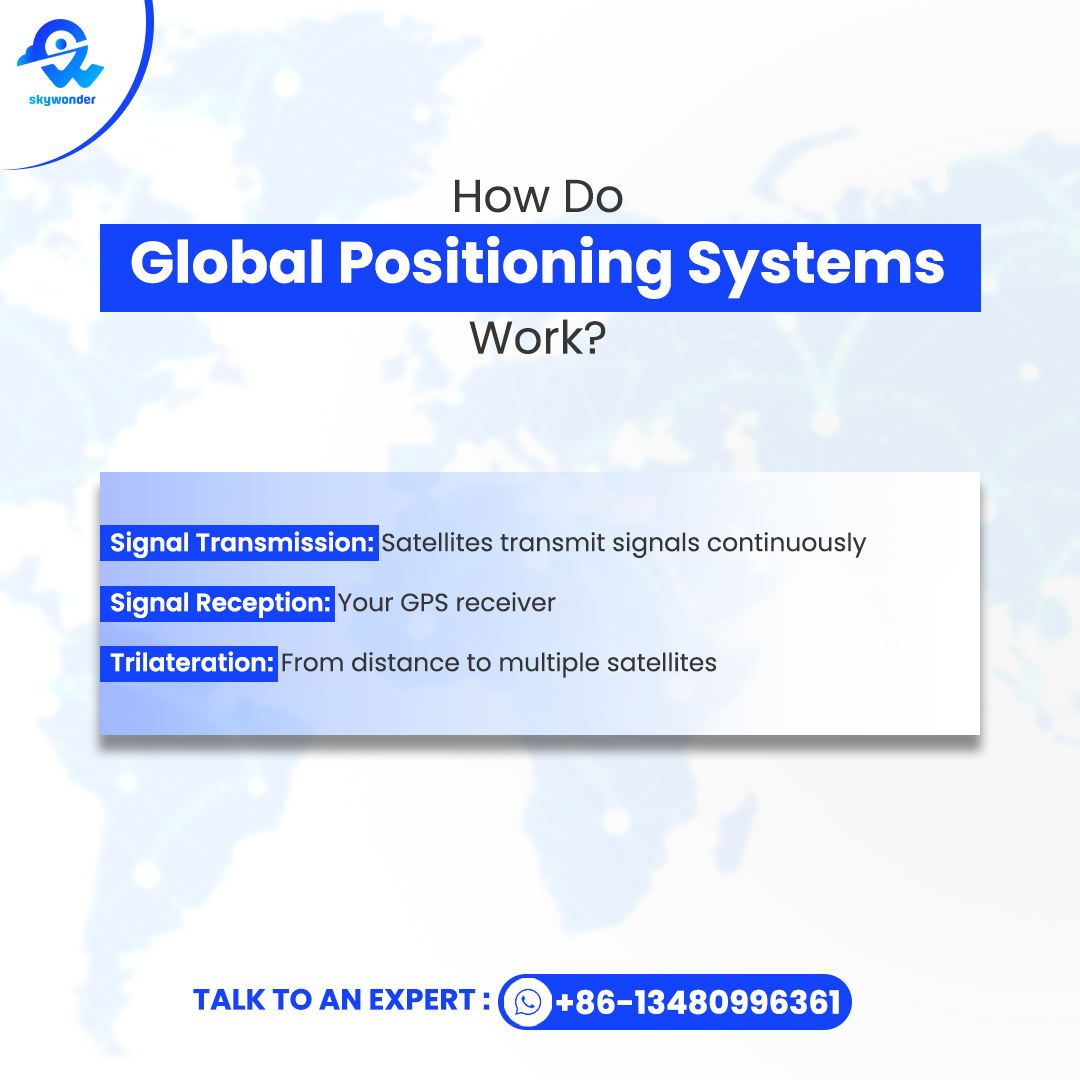
How Do Global Positioning Systems Work?
How Global Positing Systems work?
How does GPS work at a fundamental level? The system is based on principles of primitive physics and sophisticated math:
1) Signal Transmission: Satellites transmit signals continuously
Its accurate location in orbit (ephemeris data)
System time from its atomic clock
Almanac information for all satellites
2) Signal Reception: Your GPS receiver:
Compares three or more satellite signals
Measures signal travel time (light speed × time)
Calculates the distance to each satellite
3) Trilateration: From distance to multiple satellites
3 satellites provide 2D position (latitude/longitude)
4+ satellites provide 3D position (and altitude)
More satellites make it more precise on which
Which Method or Tool Is Used in GPS to Pinpoint a Location?
The mathematical process is called trilateration mathematically – the calculation of the position by measuring the known position. Triangulation reverse (angles). What is GPS and how does it work? Let’s track the process:
First Satellite: Positions you at some location on a sphere of potential points
Second Satellite: Refines to two overlapping spheres at a point
Third Satellite: Refines possibilities to two points (one typically in space)
Fourth Satellite: Provides accurate 3D position and compensates for timing errors
How Accurate Is GPS?
Standard GPS Accuracy
Smartphones: 3-5 meters open.
Car navigation: ~ 3 meters under the best reception.
Commercial GPS devices: 1 to 3 meters (3 to 10 feet) with WAAS/EGNOS correction
High-Precision GPS (GNSS) Accuracy
SystemPrecision (open sky)Best Use CaseBasic GPS3–5 metersNormal navigationGPS + GLONASS2 –3 metersImproved in jungles and urban areasGPS + Galileo1–2 metersResearch, precision agricultureGPS RTK/PPP1–3 cmAutonomous cars, drones
Factors That Influenced the Accuracy of GPS
Clear Sky View: The greater the number of satellites, the greater the accuracy.
Urban Canyons: High buildings spoil the signals, accuracy falls to 10–20 meters.
Weather: Solar storms or rain storms can interfere.
AI corrections: Smart algorithms if self-coordination in real time.
What Are the Uses of GPS?
1. Navigation and transportation
Road Navigation: GPS Powers Applications such as Google Maps, Waze, and Car Navigation.
Aviation: GPS guides the pilots for safe takeoff, landing, and air navigation.
Marítimo: The GPS guides the ships to sail safely around the ocean, arrival in the port, and prevents collision.
PUBLIC TRANSPORT: Trains and buses use general clinicians to show the time and place in real time.
2. Emergency and safety services
911 and Emergency Response: GPS helps 911 callers determine their location.
Research and Rescue: Helicopters and drones apply GPS to find lost walkers or disaster survivors.
Disaster Management: Routing Rockets, Earthquakes, and Floods for Evacuations.
3. Agriculture and Agriculture
Precision Farming: GPS tractors sow seeds and fertilizers at an inch precision.
Livestock Tracking: Farmers track cattle movement using GPS collars.
Soil Mapping: GPS drones trace soil to maximize crop yield. This is a marvelous achievement of technology that has propelled such proficiency to dizzying heights.
4. Defense and military
Missile orientation: GPS is used for accurate puncture strikes with less collateral damage.
Troop Tracking: Armed Forces use encrypted GPS for real-time battlefield coordination.
Drone operations: UAVs use GPS for recognition and strike.
5. Science and Research
Climatic Studies: GPS tracks the glacial and sea level movement.
Wildlife Conservation: Scientists accompany endangered animals with GPS necklaces.
Archaeology: GPS locates old ruins to the centimeter.
6. Daily consumer uses
Smartphones and Wearables: GPS is used by Fitbit activity monitors to find running paths.
Tour sharing: GPS is used by Uber and Lyft drivers to find pilots.
Geocaching: An Outdoor treasure hunt with GPS.
7. Industry and Logistics
Fleet Management: Companies trace delivery trucks for efficiency.
Construction: Excavators and accurate excavators.
Mining: Non-manned mining trucks guided by precision travel without risking lives.
Who Uses GPS? From Children to Astronauts
The GPS output device market has expanded dramatically:
Consumer Applications
Smartphones: 6.8 billion GNSS-capable phones in the world
Infrastructure: Syncing of telecom networks, sync of power grids
What is GNSS? Understanding Global Navigation Satellite Systems
GNSS stands for Global Navigation Satellite System – a networked system of satellites providing positioning, navigation, and timing (PNT) service worldwide. GPS is the predominant system (US-owned), but GNSS includes all other nations’ satellite nav systems, such as:
GPS (USA)
GLONASS (Russia)
Galileo (European Union)
BeiDou (China)
GPS vs GNSS – Understanding the Ecosystem
While “GPS” is commonly used generically, it’s actually one of several global positioning systems:
AI predicts and adjusts for signal delays & blockages
Crowdsourced data improves global accuracy
Makes phone navigation as precise as survey-grade GPS
Conclusion: The Ubiquitous Utility of GPS
Before us are enhanced global positioning systems that are more accurate, more reliable, and more accessible.Already aware now of what is gps and how does it works, you’ll never look over at that tiny little blue dot quite the same ever again!