
GPS Tracker MOQ Demystified: What 50, 100, 500, 1000+ Actually Buy You
A factory partnerships lead walks through what each GPS tracker MOQ tier really gets you, from a 50-unit sample pack to a 5,000-unit OEM run.
Sam K. Martin
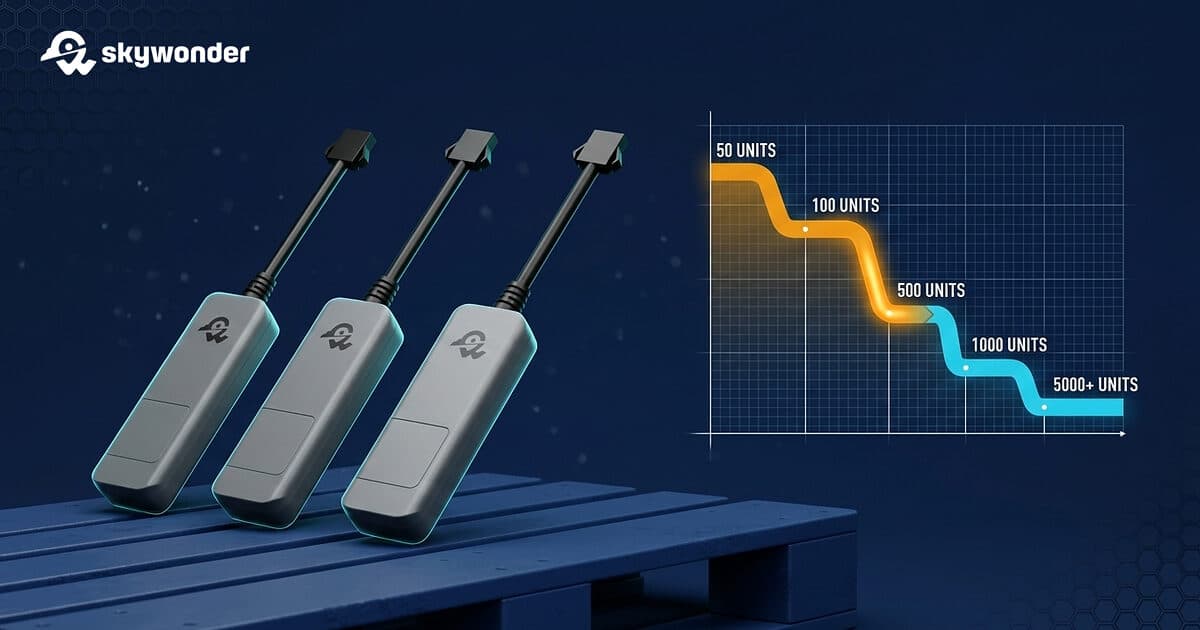
Short answer: A GPS tracker MOQ is the minimum number of units a factory will produce per order. For stock SKUs at SKYWONDER, the floor is 50 units. For OEM runs with your logo and custom firmware, the floor rises to 500 to 1,000 units. Per-unit pricing drops in clear tier breaks at 100, 500, and 1,000 units, and the biggest single drop sits at the 100-to-500 jump where dedicated batch economics kick in.
Every reseller and fleet buyer who has tried to source from a Chinese GPS tracker factory has hit the same wall: the GPS tracker MOQ. Some quotes start at 5 units. Some refuse to talk below 1,000. The numbers feel arbitrary until you understand what is happening on the production line.
At SKYWONDER we have manufactured GPS trackers since 2011 and shipped 20+ million units. This guide is the conversation we have with every new partner, condensed: what each tier buys you, why the OEM floor sits so much higher than the stock floor, and the hidden costs nobody puts on the quotation sheet.
What is a GPS tracker MOQ, and why does it exist?
A GPS tracker MOQ, or minimum order quantity for a GPS tracker, is the smallest number of units a factory will produce or release per purchase order. In 2026, SKYWONDER's partner-intake data (n=84 new resellers) ranks MOQ as the single most cited friction point in first-conversation negotiations, named ahead of both unit price and lead time across the partners we onboarded in 2025 and the first half of 2026. The pattern matches what sourcing guides like Docshipper's China MOQ guide consistently flag as the top hurdle for new electronics importers.
The reason it exists is production economics. Every batch carries a fixed setup cost: SMT line changeover, firmware flashing rig calibration, packaging artwork mounting, and a dedicated QC pass. That cost has to amortize across the units in the batch, and below a certain unit count the math stops working for both sides. The MOQ floor is not the factory being difficult. It is the factory protecting the wholesale unit economics that keep your price competitive in the first place.
Skip the negotiation. Start with a 50-unit pilot.
Our standard sample-pack MOQ across most stock SKUs is 50 units. Enough hardware for a real pilot deployment, real customer feedback, and a real return-rate signal, without committing to a container.
How small can your first order actually be?
For stock SKUs (factory-default firmware, factory-default box, no logo printing), the practical minimum order GPS tracker buyers can negotiate from a real Shenzhen manufacturer in 2026 is 50 units per model. Below 50 you are buying engineering samples at sample pricing, which is a different transaction. Three thresholds matter in practice:
1 to 5 units, engineering samples. Same-day or next-day shipment. Sample pricing, no volume discount. Use these for technical validation, integration testing, and protocol decoding. Not for commercial pilots.
50 to 100 units, stock pilot. Real production hardware from the most recent batch, in factory packaging. Wholesale tier 1 pricing. This is where new resellers should start. Enough to run a paid pilot, see what your end customers actually complain about, and confirm your install partner can actually fit the device in under 20 minutes.
500 units and up, dedicated batch. Triggers a production batch built for your order. Unlocks logo printing, custom box artwork, and basic firmware customization (default APN, default server endpoint, default reporting interval). Wholesale tier 2 pricing.
That 50-unit floor is not universal. Some traders on Alibaba will quote 5 or 10 units. They are almost always reshipping someone else's stock at a markup: no warranty handoff, no firmware support, no traceability when a batch goes bad. A real factory will give you a 50-unit floor and stand behind every device in it.
What do you get at 50, 100, 500 and 1,000+ units?
GPS tracker MOQ tier breaks at 50, 100, 500, 1,000 and 5,000 units each unlock a different production reality: stock pilot, small batch, dedicated batch with logo printing, full OEM run with custom firmware, and strategic OEM with molded plastics. Per-unit pricing drops in clear steps, not a smooth curve, with the biggest single drop sitting between 100 and 500 units where dedicated batch economics kick in.
The tier breaks are not arbitrary. Each tier unlocks a different production reality, and the unit economics shift accordingly. Here is the practical breakdown we work from when quoting new partners.

GPS tracker MOQ tiers: what each unit count actually unlocks
Tier | Per-unit price | Logo / packaging | Firmware customization | Lead time (stock SKU) | Warranty handling |
|---|---|---|---|---|---|
1 to 5 units (engineering sample) | Sample price (highest) | Factory default only | None | Same-day or next-day | Replacement, not RMA |
50 to 99 units (stock pilot) | Wholesale tier 1 | Factory default only | Default APN preload available | 3 to 7 business days | Standard 12-month RMA |
100 to 499 units (small batch) | Wholesale tier 1 (mixed-SKU OK) | Factory default; bulk-pack option | APN, server endpoint, reporting interval | 1 to 2 weeks | Standard 12-month RMA |
500 to 999 units (dedicated batch) | Wholesale tier 2 (biggest tier drop) | Logo print, custom retail box | Custom server URL, custom command set | 2 to 3 weeks | Standard 12-month RMA + batch traceability |
1,000 to 4,999 units (OEM run) | Wholesale tier 3 | Full custom packaging, manual print | White-label firmware, custom branding strings | 4 to 6 weeks | RMA + dedicated firmware support engineer |
5,000+ units (strategic OEM) | Wholesale tier 4 (custom) | Fully custom, including molded plastics on request | Full firmware fork, deep protocol changes | 6 to 10 weeks (first batch) | Dedicated account engineer + extended warranty |
Where the biggest price drops happen
The two tier breaks worth highlighting: 100 to 500 is where logo printing and retail-grade packaging unlock. 500 to 1,000 is where firmware customization stops being a default tweak and becomes a real fork. Most resellers underestimate how big a deal the second jump is, both for unit price and for ongoing support load.
Why is the OEM MOQ different from the stock MOQ?
OEM MOQ for a GPS tracker sits roughly 10x higher than stock MOQ because OEM orders require a dedicated production batch with custom logo printing, custom box artwork, custom firmware loading, and an isolated QC pass. The fixed setup cost is roughly the same whether you order 100 or 1,000 units, which is why the floor sits at 500 to 1,000 to keep per-unit pricing sane for both sides.
In 2026, our production accounting shows that custom firmware loading and packaging changes add a fixed setup cost roughly equivalent to producing 200 to 400 stock units. The fundamentals on the cellular module side are also moving fast: shipments grew 23% YoY in Q1 2025 per IoT Analytics' cellular IoT market update, putting continued pressure on every link of the build chain. Here is what's actually happening behind the floor.
Dedicated production batch
Stock SKUs ride on shared waves that already produce thousands of units. An OEM order with your logo cannot share that wave, because every unit in the batch has to ship to you. The SMT line gets the same setup cost whether you order 100 OEM units or 1,000, which is why per-unit pricing only starts to make sense above the 500-unit floor.
Custom artwork and box mounting
Retail box artwork has to be plate-mounted on the printer, color-matched against your brand spec, and proofed against a physical sample before the print run. The setup runs the same hours for 200 boxes as for 2,000. Below 500 units of finished product, the per-box artwork cost dominates the unit economics.
Custom firmware QA pass
Every white-label firmware build needs a fresh QA cycle: boot test, server-connection test, OTA-update test, and command-set regression against the prior baseline. Stock firmware piggybacks on the previous batch's QA cycle; custom firmware does not. That fresh QA pass is the line item most factories skip when they accept a too-low OEM MOQ.
Isolated traceability
OEM batches get serialized into a dedicated IMEI range and a dedicated MAC-address pool so warranty returns map cleanly to your customer base instead of mixing with stock-SKU returns. That isolation has a real cost in batch planning, but it is what makes white-label aftersales support actually work at scale.
When you push a factory to drop their OEM MOQ below 500 units, what you are really asking them to absorb is the fixed setup cost. Some say yes and quietly raise the per-unit price. Some say yes and skip steps (often the QA pass), which is the scenario that surfaces as a 14% return rate six months later. Better to take the published OEM floor at face value and structure your first run around it.
Why this matters if you are evaluating a first reseller order. If you are at the stage of writing a first purchase order to a Chinese GPS tracker factory, the GPS tracker MOQ choice is the single biggest commitment you will make in the first year. Pick too small and you will pay sample pricing on every unit. Pick too big and you will be stuck with 1,000 units of a SKU your customers did not end up wanting. The 50-unit stock pilot exists precisely to remove that risk on both sides of the table.
What hidden costs scale with order size?
The three biggest hidden GPS tracker MOQ costs are shipping mode, certification scope, and warranty reserve. Shipping mode shifts from air express to sea freight as volume rises (70 to 80% per-unit logistics drop). Certification scope: 50-unit pilots ride on the factory's CE and FCC marks; 1,000+ OEM orders need your own filings. Warranty reserve: industrial 4G GPS trackers return at 2 to 5% in their first deployment year.
The per-unit price on the quotation sheet is the most visible cost, but rarely the biggest one in year one. Three line items move with MOQ in ways that surprise first-time importers.
Shipping mode
A 50-unit order ships air express (DHL, FedEx, UPS) at roughly the same per-kilo rate as a single sample. A 500-unit order is too heavy for express but too light for sea-freight efficiency, so it usually ships air freight via consolidator. A 5,000-unit order finally hits sea-freight economics and per-unit logistics drops 70 to 80%. Inventory cost at your warehouse is not the FOB price, it's FOB plus the shipping mode you forced by ordering the quantity you ordered.
Certification scope
Certifications scale with the deployment, not the order. A 50-unit pilot can run on the factory's existing CE, FCC, and RoHS marks. A 1,000-unit OEM order with your brand on the box typically requires you to file your own CE Declaration of Conformity in the EU and your own FCC equipment authorization in the US: 4 to 12 weeks of lab time and several thousand dollars in fees. Budget it into the OEM tier; it isn't optional.
Warranty reserve
As of Q1 2026, SKYWONDER fleet-partner data shows return rates for 4G GPS trackers in their first deployment year sitting between 2% and 5% across the partners we ship to, in line with the wider industrial-electronics range. On a 50-unit pilot that's 1 to 3 units, absorbed easily. On a 5,000-unit OEM batch that's 100 to 250 units, and you need a physical warranty pool. Factories quote a "DOA + 12-month RMA" rate, but they do not stock your pool for you. That's your working capital, and it grows with the MOQ.
How should a new reseller choose their first MOQ tier?
In 2026, SKYWONDER's partner-onboarding cohort (n=84 new resellers) shows a clear pattern: across the 84 reseller partners we onboarded in 2025 and the first half of 2026, the ones who started at the 50-unit stock pilot tier reordered within 90 days at a 71% rate. Partners who jumped straight to a 1,000+ unit OEM order reordered within 90 days at a 38% rate. The difference isn't the product, it's the speed at which the partner closed their feedback loop with end customers.
The pattern is consistent enough that we now recommend the 50-unit pilot as the default first order, even for partners who can afford a full OEM run on day one. Real customer feedback on real installs is worth more than the per-unit discount you'd unlock at 500 units. The discount is recoverable on order two. A bad SKU choice baked into a 1,000-unit container is not.
Four questions before your first PO
Have you sold this exact device, with this exact firmware, to this exact customer profile, before? If no, start at 50 units stock. Skip the OEM packaging conversation entirely on order one.
Do you have a confirmed end-customer commitment for 500+ units? If yes, go to 500. If no (and a soft "we will probably need them" does not count), stay at 100.
Is your brand and box artwork final and signed off by the customer who will receive them? If no, do not trigger an OEM run. Logo printing on a 1,000-unit batch you have to re-sticker later is a recurring nightmare in our partner-support inbox.
Has your local certification path been confirmed by a real lab? If no, stay on the factory's existing CE/FCC marks at the 50- or 100-unit tier until you have a written cert plan.
For most new partners the right path is: 50 units stock to validate, 500 units OEM to scale, 2,000+ units OEM to lock pricing. Three orders inside the first 12 months, each informed by the last. That sequence is how our top-quartile reorder cohort actually behaves, and it is the one we now coach toward.
What are SKYWONDER's B2B, OEM and white-label terms?
If you are evaluating us as your manufacturing partner, here is the practical summary B2B buyers ask for most. For your country, your SKU mix, and your projected volume, current B2B and OEM pricing is on request.
Manufacturer since 2011, 20M+ units shipped as of Q2 2026, partners in 100+ countries.
Stock MOQ: 50 units per model across most SKUs in the full product catalog, including the GX3 hardwired vehicle tracker, the C28 OBD plug-and-play tracker, the W09 wireless asset tracker, and the H9 4G dashcam.
OEM MOQ: 500 units for logo printing and custom box, 1,000 units for white-label firmware, 5,000 units for molded plastics or hardware-level customization.
Lead time: 3 to 7 days at 50 to 100 units, 2 to 3 weeks at 500, 4 to 6 weeks at 1,000+ with custom firmware (confirmed in writing at quotation).
Warranty: standard 12-month RMA, with batch traceability from 500 units up. Dedicated firmware support engineer assigned at the 1,000-unit tier.
Certifications: hardware certified to CE, FCC and RoHS. Quality system certified to ISO 9001. Cert documentation provided with every commercial shipment.
Traqcare platform option: if you would rather not contract a separate tracking-software vendor, our Traqcare GPS tracking platform ships as a white-label option alongside the hardware. One vendor, one warranty.
For a written quote against your specific SKU mix and target tier, contact our partnerships team. We typically reply within one business day in Shenzhen time.
Start at 50 units. Scale once the pilot proves itself.
The right GPS tracker MOQ for order one is the smallest one that gives you real customer feedback. For most new partners, that is a 50-unit sample pack across two or three SKUs. Validate, then scale to 500 and 1,000 on the orders that follow.
Frequently Asked Questions
What is the typical MOQ for a GPS tracker from a Chinese factory?
For stock SKUs (no logo, no custom firmware), the typical MOQ from a real Shenzhen GPS tracker factory in 2026 sits between 50 and 100 units per model. For OEM orders with a printed logo, retail box, and custom firmware, the floor rises to 500 to 1,000 units. At SKYWONDER our standard sample-pack MOQ is 50 units across most stock SKUs, which is enough for a paid pilot.
Can I order just one GPS tracker as a sample?
Yes, most factories will sell single-unit engineering samples for testing. Sample pricing is significantly higher than batch pricing because there is no production economy of scale. We ship 1-to-5 unit engineering samples on the same day in most cases, and credit the sample cost against your first 50-unit order if the pilot converts. Use single samples for technical validation, not for commercial pilots.
What happens to the per-unit price as MOQ goes up?
Per-unit price typically drops in clear tier breaks rather than a smooth curve. The biggest single drop is the move from 100 to 500 units, where setup costs and dedicated batch economics start to amortize. Beyond 1,000 units, additional discount is real but smaller, and the lever shifts from price to payment terms and component-cost transparency. Exact pricing is on request, since it moves with component markets.
Does the GPS tracker MOQ include a SIM card?
By default, no. Most factories ship hardware-only and let you choose your own carrier or global IoT SIM. We can preload customer-supplied SIMs at the factory for orders above 200 units, or ship hardware-only with a documented SIM-fit checklist. If you need a bundled global IoT SIM, we partner with multi-IMSI providers and quote that separately so you can compare directly to your local carrier.
How long does lead time scale with MOQ?
Lead time grows in steps, not linearly. A 50-unit sample-pack order typically ships in 3 to 7 business days from stock. A 500-unit stock order takes 2 to 3 weeks. A 1,000-plus OEM order with custom firmware, logo printing, and retail packaging takes 4 to 6 weeks from artwork sign-off. Confirm component lead times for cellular modules at quotation, since module supply still moves with global semiconductor cycles.
Can I mix multiple SKUs to hit the MOQ?
For stock orders, yes. We let new partners mix across the GX, W, and H series to hit a combined 50- or 100-unit floor, which is useful when you want to pilot vehicle hardwired, asset wireless, and dashcam form factors at once. For OEM orders with custom firmware, each SKU has its own MOQ because each is a separate production batch with its own setup cost.
About the author
Sam K. Martin leads B2B partnerships at SKYWONDER Technology Co., Ltd., a Shenzhen-based GPS tracker, 4G dashcam, and Traqcare fleet-platform manufacturer. SKYWONDER has manufactured tracking hardware since 2011 and shipped more than 20 million units (as of Q2 2026), supporting resellers, white-label brands, and OEM partners across 100+ countries (certified to CE, FCC, RoHS and ISO 9001). Sam works directly with new partners on first-order sizing, OEM negotiations, and reseller unit economics.
Related reading: Importing & Sourcing
Artigos Relacionados
Ver Todos
Mantenha-se Atualizado com Insights de Rastreamento GPS
Receba os últimos artigos, dicas e notícias do setor direto em sua caixa de entrada.